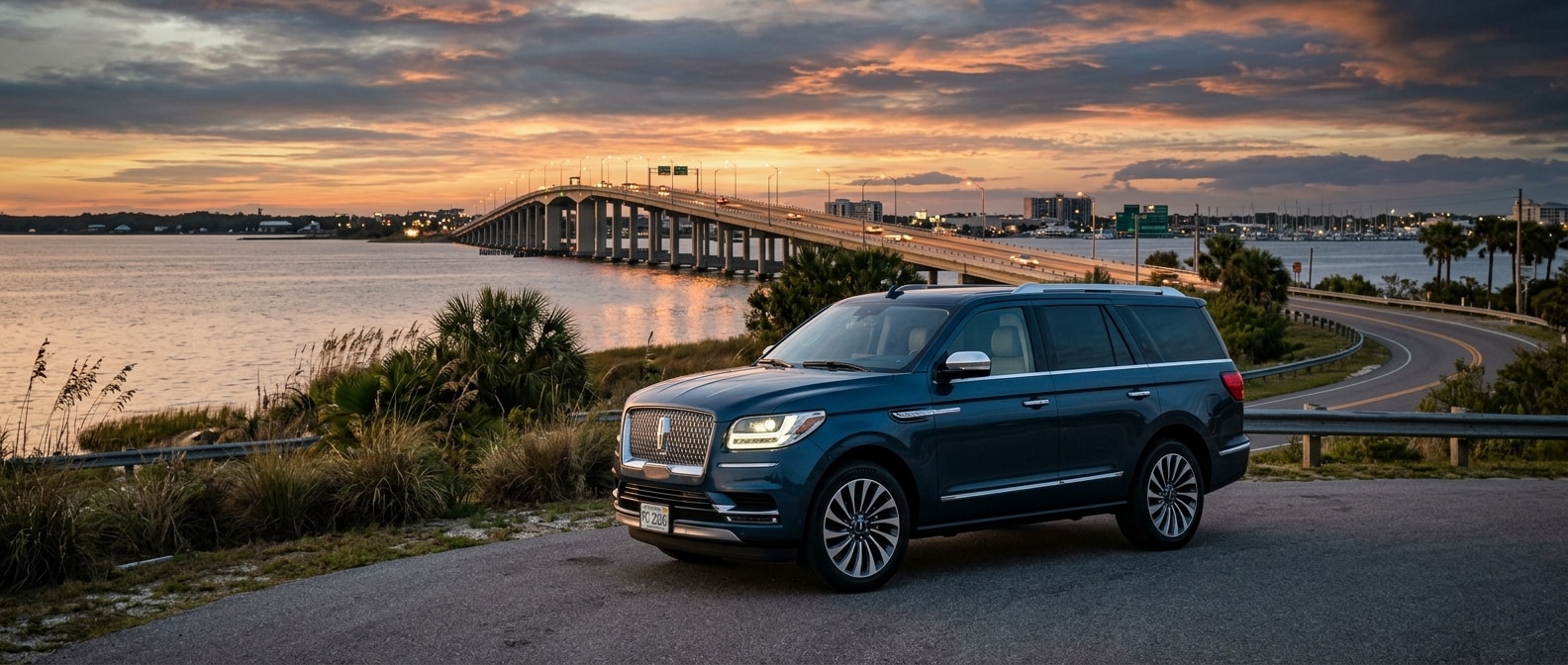
If you drive the Hathaway Bridge corridor regularly, tow a boat to St. Andrew Bay on the weekends, or run the ECP airport pickup for a second-home family coming in from Atlanta or Dallas, the Navigator already fits your life in a way that's settled. What actually takes work is deciding whether you should own it or drive it on a lease.
Either way, The 2026 Lincoln Navigator is a compelling full-size luxury SUV; the work in this decision is whether to own it or lease it. The buy-vs.-lease math here shifts on two things most generic guides never reach. One is how many miles you put on annually along the Panhandle's long coastal corridors. The other is whether you lean on that 8,700-pound tow rating with any regularity.
- If you drive under 12,000 miles a year and want a new Navigator every three years, leasing limits your exposure to the steep early depreciation curve.
- If you tow a boat, a trailer, or anything else with real frequency, buying is safer. Lease wear-and-tear provisions treat towing as commercial use in some contracts, which creates end-of-term exposure.
- The Navigator L adds 11.9 inches of length and 14.5 cubic feet of cargo space over the standard wheelbase. Pack for a week and that space earns its keep. Pack light and you'll never notice it.
- Premiere trim buyers give up one significant thing. Second-row captain's chairs aren't available on that trim level, so know that before you configure.
- Our team's honest take, for the Bay County buyer who plans to hold the vehicle, is that buying at the Reserve trim makes the most long-term sense. But there's a profile where leasing wins, and we'll show you exactly what it is.
What's the Real Difference Between Buying and Leasing a Navigator?
Buying a Navigator means you own the depreciation outright and every mile after, while leasing means you pay only for the slice of depreciation that happens during your term, with the residual value locked in on day one and the risk sitting with the lender. Both put the same SUV in your driveway. The split lands on who carries the loss when values move.
| Decision Axis | Buying | Leasing |
|---|---|---|
| Who absorbs depreciation risk | You | Lincoln Financial |
| Mileage flexibility | Unlimited | Typically 10,000-15,000 mi/year cap |
| Towing use | No restriction | Can trigger wear provisions |
| End-of-term equity | Yes, if value holds | None (unless residual exceeds market) |
| Upfit / modification | Allowed | Generally restricted |
| Upgrade cycle | Your choice | Built into term length |
| Best for | High-mileage or long-hold buyers | Lower-mileage, upgrade-focused buyers |
The Navigator carries a twin-turbocharged 3.5-liter V6 producing 440 horsepower and 510 pound-feet of torque, paired to a 10-speed automatic and standard four-wheel drive. That powertrain doesn't change between the standard and L wheelbase. Neither does the EPA estimate of 15 city and 22 highway miles per gallon. What changes with the L is strictly dimensional, and we'll get to that.
Does the Mileage Question Really Matter on the Panhandle?
The mileage question matters more here than in most markets, because Bay County is a long-corridor market and daily distances add up fast here, and a lease cap that looks generous on paper can quietly become an overage bill by the time you hand back the keys. So yes, it matters.
From Panama City to Marianna on US-231 is roughly 50 miles each way. Round-trip to Panama City Beach via US-98 over the Hathaway Bridge and back is a daily errand, not an exceptional drive. A buyer splitting time between a primary residence and a 30A property can cross 20,000 miles annually without a single long trip. A mileage profile like that is the lease killer.
The Navigator L and the standard Navigator share the same lease structure and the same mileage provisions. Neither wheelbase gets you out from under an overage charge if you're consistently driving at Panhandle distances.
Our team's direct observation lines up with what Lincoln Financial's published lease terms reflect. The 10,000-mile-per-year cap is where most luxury leases start, and buyers who pick that option underestimate Bay County driving patterns by a meaningful margin.
If your annual mileage reliably runs above 14,000, the case for buying sharpens considerably. If you're below 12,000, leasing deserves a serious look.
Explore Your Financing Options
The Towing Reality: Navigator vs. Navigator L for Bay County Boat Owners
The 2026 Navigator is rated to tow up to 8,700 pounds when properly equipped with the available heavy-duty tow package, which covers center-console boats, pontoons, and most bay-fishing rigs common to St. Andrew Bay, and the Navigator L carries the exact same rating under the same conditions. Wheelbase doesn't change what you can pull.
Most buy-vs.-lease guides skip this part entirely. If towing is part of your regular use, leasing gets complicated. Lease agreements define normal wear and tear, and sustained trailer towing puts real load on hitches, receiver mounts, wiring harnesses, transmission cooling systems, and tires. The heavy-duty tow package adds a trailer brake controller, an upgraded radiator, and a two-speed transfer case (all of it working hard the moment a loaded trailer hooks up). At the end of a 36-month lease, the inspection for excess wear is literal and specific.
On our lot, a Navigator that's spent its life pulling a bay boat shows it first at the receiver hitch and the tire shoulders, well before anything trips a warning. The wear is physical, and an end-of-term inspector reads it the same way we do.
Talk to our finance team before structuring a lease around a tow-capable Navigator. The conversation changes the moment you tell them how often that hitch actually sees a trailer.
For buyers who tow with any regularity, ownership is the cleaner path. You absorb the depreciation, but you don't answer for wear at the end of a term.
Standard vs. Long Wheelbase: What the L Actually Buys You
The Navigator L stretches to 221.9 inches against the standard Navigator's 210 inches, and those 11.9 extra inches don't feed the cabin at all. They go straight into cargo space behind the third row, which is the one place the two wheelbases genuinely part ways.
Behind the third row, the standard Navigator holds 22.9 cubic feet; the Navigator L holds 37.4. That's the difference between luggage for a weekend and luggage for a week. For families who pack seriously for beach trips along the Panhandle, or who need room for gear, strollers, and third-row passengers at the same time, the L resolves a genuine conflict. For buyers who mostly run two or three people and light cargo, the standard wheelbase is the more agile choice in parking structures and tight turnarounds downtown.
Both configurations offer Premiere, Reserve, and Black Label trims. One detail worth knowing before you spec a Premiere is that the trim doesn't offer second-row captain's chairs as an option. Move up to Reserve and that choice opens. For a buyer prioritizing lounge-style second-row seating, one of the Navigator's genuine differentiators in this segment, that trim step matters.
Which Should You Pick?
Which way you go comes down to which of three profiles sounds like your driveway, and the straight answer is that no single choice wins for everyone in Bay County. Mileage, towing, and how long you plan to hold the vehicle sort most people cleanly into one of them. Let's walk all three.
Buyer profile A is the in-town commuter. You're in Panama City full-time, drive 10,000 to 12,000 miles a year, want BlueCruise standard on every highway mile of the US-98 run, and you plan to upgrade at the end of three years. Leasing the standard Navigator at Reserve trim gives you all of it, the hands-free highway driving, the 48-inch panoramic display, the second-row captain's chairs, and a clean exit in 36 months without absorbing a depreciation curve that runs steep in years one and two for full-size luxury SUVs.
Buyer profile B is the weekend hauler. You tow a bay boat to St. Andrew Bay regularly, drive a combined Marianna-Panama City-Beach triangle that adds up fast, and you intend to keep the vehicle past five years. Buying the standard Navigator, or the L if the cargo reality fits, is the right answer. The ownership math improves considerably once the initial depreciation slope flattens after year two, and there's no lease end-of-term inspection to navigate.
Buyer profile C is the full-house family. Your use case includes a family that fills all three rows, gear for a week, and airport runs from ECP for extended family arriving from out of town. The Navigator L bought outright is probably the most honest answer. More cargo space, no mileage clock, and no wear-and-tear accounting.
Frequently Asked Questions
Is the 2026 Lincoln Navigator available right now, and does it come in the extended version?
Yes. The 2026 Navigator is the current model year, offered in both standard and long-wheelbase Navigator L configurations. Both share the same 440-horsepower twin-turbocharged V6, 10-speed automatic, and standard four-wheel drive. The practical differences come down to length, 210 inches for the standard and 221.9 inches for the L, cargo space behind the third row, 22.9 cubic feet versus 37.4 cubic feet, and a modest difference in fuel economy. Both can be configured in Premiere, Reserve, or Black Label trim.
Can I tow my boat if I lease a Navigator?
Technically, the 2026 Navigator is rated to tow up to 8,700 pounds when equipped with the heavy-duty tow package, and it's fully capable under a lease. The question is what happens at the end of the term. Lease contracts define acceptable wear, and sustained towing generates measurable wear on tow-specific components. Our team recommends having that conversation with our finance office before you structure a lease around regular towing use. For buyers who haul frequently, ownership removes that end-of-term variable entirely.