
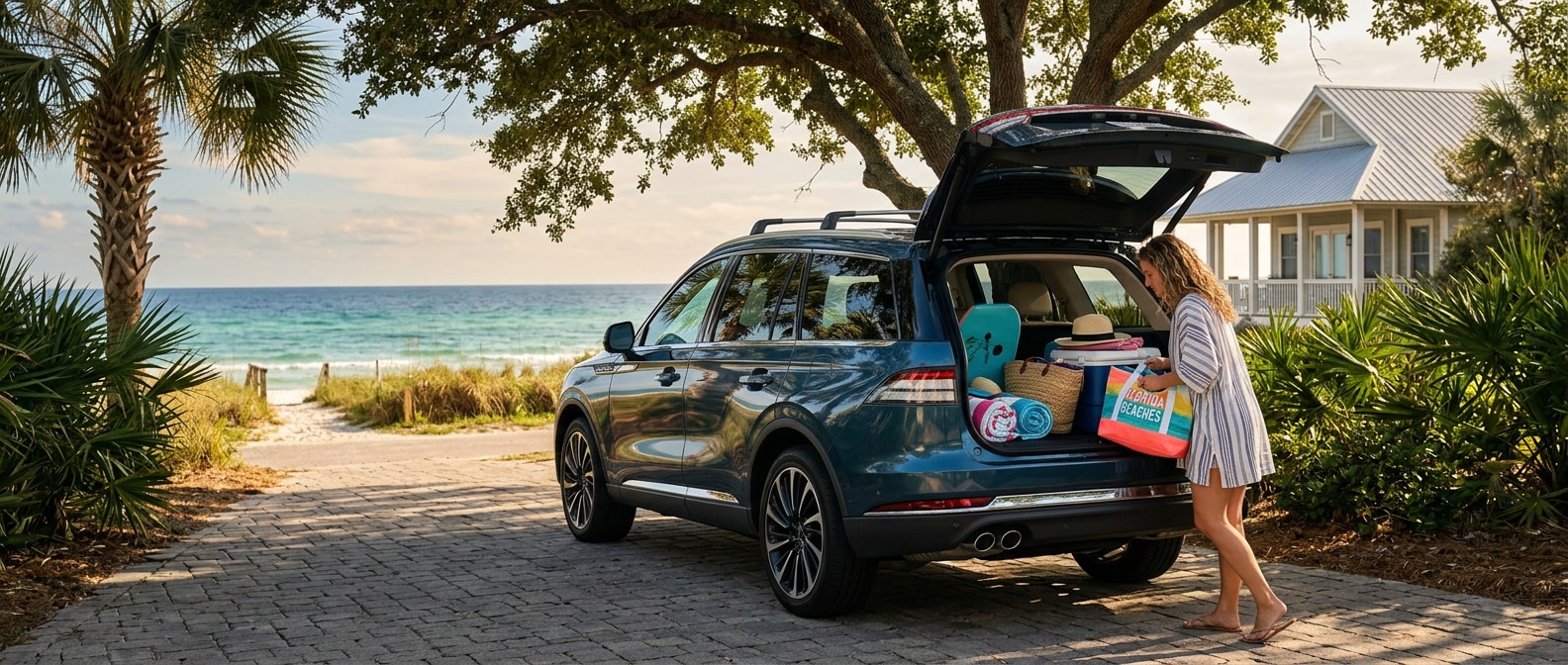
If you're planning to trade into a 2027 Lincoln Aviator from a vehicle you've owned on the Panhandle, the answer isn't simply the trim that catches your eye first. Much of it comes down to how your current vehicle's condition, trim, and mileage line up with what Gulf Coast appraisers are actually seeing, and what that does to the net cost of your move. The Reserve fits the widest range of Glenwood-area buyers, since it carries the full comfort and technology package, holds value more predictably here than the base Premiere, and bridges the gap without the Black Label premium. Read on for the specifics that actually decide it.
What Does Each 2027 Aviator Trim Actually Give You?
Every 2027 Aviator runs the same twin-turbocharged 3.0-liter V6, rated by Lincoln at 400 horsepower and 415 lb-ft of torque, sent through a 10-speed automatic, with towing rated at 5,000 pounds when properly equipped, so what separates the trims is the ownership experience layered around that shared foundation. A few of those layers matter more than others when you're both trading in and choosing what to move into.
| Feature | Premiere | Reserve | Black Label |
|---|---|---|---|
| Seating capacity | 6 | 6 or 7 (bench option) | 6 |
| Drive type | RWD standard, AWD optional | RWD standard, AWD optional | AWD standard |
| BlueCruise hands-free highway | Standard, 4-yr subscription | Standard, 4-yr subscription | Standard, 4-yr subscription |
| 13.2-inch touchscreen | Standard | Standard | Standard |
| Leather upholstery (rows 1-2) | Not standard | Standard | Standard |
| Ventilated second-row seats | Not included | Standard | Standard |
| 30-way power front seats | Not included | Reserve II package | Standard |
| 28-speaker Revel audio | Not included | Reserve II package | Standard |
| EPA fuel economy (RWD) | 17 city / 25 hwy / 20 combined | 17 city / 25 hwy / 20 combined | AWD only |
| EPA fuel economy (AWD) | 17 city / 24 hwy / 20 combined | 17 city / 24 hwy / 20 combined | 17 city / 24 hwy / 20 combined |
| Max towing (properly equipped) | 5,000 lbs | 5,000 lbs | 5,000 lbs |
The most important change for 2027 is that BlueCruise hands-free highway driving is now standard across every trim, including the Premiere. Worth pausing on that one. Buyers used to move up to Reserve specifically for the hands-free capability, and that logic no longer applies. So the conversation shifts, do you want leather seating and the ventilated second-row comfort on longer Panhandle runs, or does the Premiere's content cover what you need?
For most buyers here, the Reserve earns its place. The leather interior and ventilated rear seating are genuinely relevant on a summer drive up US-231 toward Marianna, where the cab temperature climbs fast and a second row of adults notices. The seven-passenger bench configuration is only available on the Reserve, which matters if you're regularly running a full load. And the Reserve's standard surround-view camera earns its keep in the tight parking situations you meet near Historic St. Andrews.
If the Reserve II package's 30-way seats and Revel audio appeal to you, they're available as an option on the Reserve, which gets you most of what the Black Label delivers without the top-tier premium. The Black Label's three interior themes (Invitation, Flight, and Moonbeam) and its curated ownership experience are worth it for the right buyer. Just not the majority.
The Navigator is worth a look if you need more cargo depth or plan to tow often near the upper end of the Aviator's rating. Otherwise, the Aviator is the call.
What Does Your Current Vehicle's Condition Do to the Trade-In Number?
Your current vehicle's condition does more to the trade-in number on the Gulf Coast than almost any other factor, which is exactly the variable most generic trade-in guides bury in a footnote. Salt air, humidity, and UV exposure compress the spread between condition grades faster here than in an inland market, so condition is the primary lever, not a rounding error.
The appraisal itself is a physical inspection covering exterior finish, undercarriage, interior wear, tire tread depth, and functional checks of every powered feature. Each category responds directly to how a vehicle was stored and maintained in a humid subtropical climate. Call it a calibration rather than alarmism.
A documented service history converts a subjective "good condition" assessment into a verifiable one. That documentation is the single most transferable lever in a Gulf Coast trade-in appraisal.
Our team sees the difference at the appraisal stage. A vehicle with a complete, timestamped service record doesn't just look cared for, it's provably cared for, and appraisers score that differently than an equivalent vehicle with gaps. Before you bring an Aviator in for evaluation, confirm that the PowerFold third-row, the approach-activated liftgate, and the adaptive suspension are all working. Those are the powered features appraisers check specifically, and a non-functioning liftgate on a vehicle at this level moves a score from excellent to good in a hurry.
One specific note applies to anyone trading a 2020-through-2024 Aviator. Lincoln offered a Grand Touring PHEV variant in those years, and that drivetrain has since been discontinued. If your vehicle is a Grand Touring, high-voltage battery health becomes a factor in the appraisal conversation. Not a disqualifier, just a variable worth understanding before you walk in rather than after.
- Compile your complete service record before the appointment
- Test all powered features, including the liftgate, PowerFold third row, and air suspension if equipped
- Note your trim and whether it has AWD, since Reserve and Black Label trim levels tend to hold value better in this market
- Inspect painted lower panels and the undercarriage for oxidation or UV surface wear
- Check tire tread depth, because worn tires appear in the inspection report and affect the condition score
Start your trade-in estimate online before your appointment, and bring that figure into the conversation separately from the new-vehicle discussion. Keeping those two numbers on different tracks is the cleanest way to evaluate both clearly.
Does the Season You Trade Actually Matter in This Market?
The season does matter in this market, modestly, and September happens to sit in a quieter stretch for three-row luxury SUV trades on the Panhandle, with summer demand eased and the peak buyer activity from May through August already behind us while dealers build fall and end-of-year inventory. A clean, documented Aviator in good condition is exactly what the market absorbs well in this window, not because anyone's doing you a favor, but because supply and demand align a little more favorably than they do mid-summer when the lot is stacked and appraisal attention is compressed.
Depreciation is a real consideration with the Aviator as a long-term ownership vehicle. It depreciates, as most three-row luxury SUVs in this segment do. What the Aviator returns is a composed, quiet cabin, a powertrain that doesn't need to be driven hard to feel capable on the highway, and a maintenance profile that stays predictable for a buyer who services on schedule. If you're keeping the vehicle five or more years, the depreciation curve matters less than the daily experience. If you're trading every two to three years, the trim you choose and how you maintain it have a direct effect on where that curve lands when you come back in.
The Nautilus is worth a conversation if you're open to a two-row. It parks more easily, rides quietly on highway runs, and carries a different trade-in profile. But if three rows are the requirement, the 2027 Aviator is a specific, well-considered vehicle for the way people actually use a large SUV on this stretch of the Panhandle.
Frequently Asked Questions
What is the current model year of the Lincoln Aviator?
The 2027 Lincoln Aviator is the current model year as of fall 2026. It's available in three trim levels: Premiere, Reserve, and Black Label. All three share a twin-turbocharged 3.0-liter V6 producing 400 horsepower and 415 lb-ft of torque, a 10-speed automatic transmission, and BlueCruise hands-free highway driving as a standard feature. The Premiere and Reserve offer rear-wheel drive standard with all-wheel drive optional; the Black Label comes with all-wheel drive standard.
Does the Gulf Coast climate affect Lincoln Aviator trade-in values compared to inland markets?
It can, yes, if the vehicle hasn't been maintained with the climate in mind. Year-round Gulf humidity, salt-air proximity, and UV intensity accelerate surface and undercarriage wear compared to drier inland markets. The Aviators that hold their appraisal scores on the Panhandle are the ones with documented service records, regular exterior care, and covered or garage storage. A well-maintained example here trades on par with any other market. An unmaintained one shows the spread more visibly.
Which Lincoln Aviator trim holds its trade-in value best?
Reserve and Black Label trims hold value more predictably in this market than the base Premiere. The Reserve's leather interior, available AWD configuration, and higher amenity level position it well with buyers stepping into a pre-owned luxury three-row on the Panhandle, which translates to stronger appraiser demand at trade-in. The Black Label holds similarly, though its premium is harder to fully recover at trade. For most buyers aiming to maximize trade-in value at the point of the next upgrade, the Reserve with AWD is the trim to target.
Categories:
Social