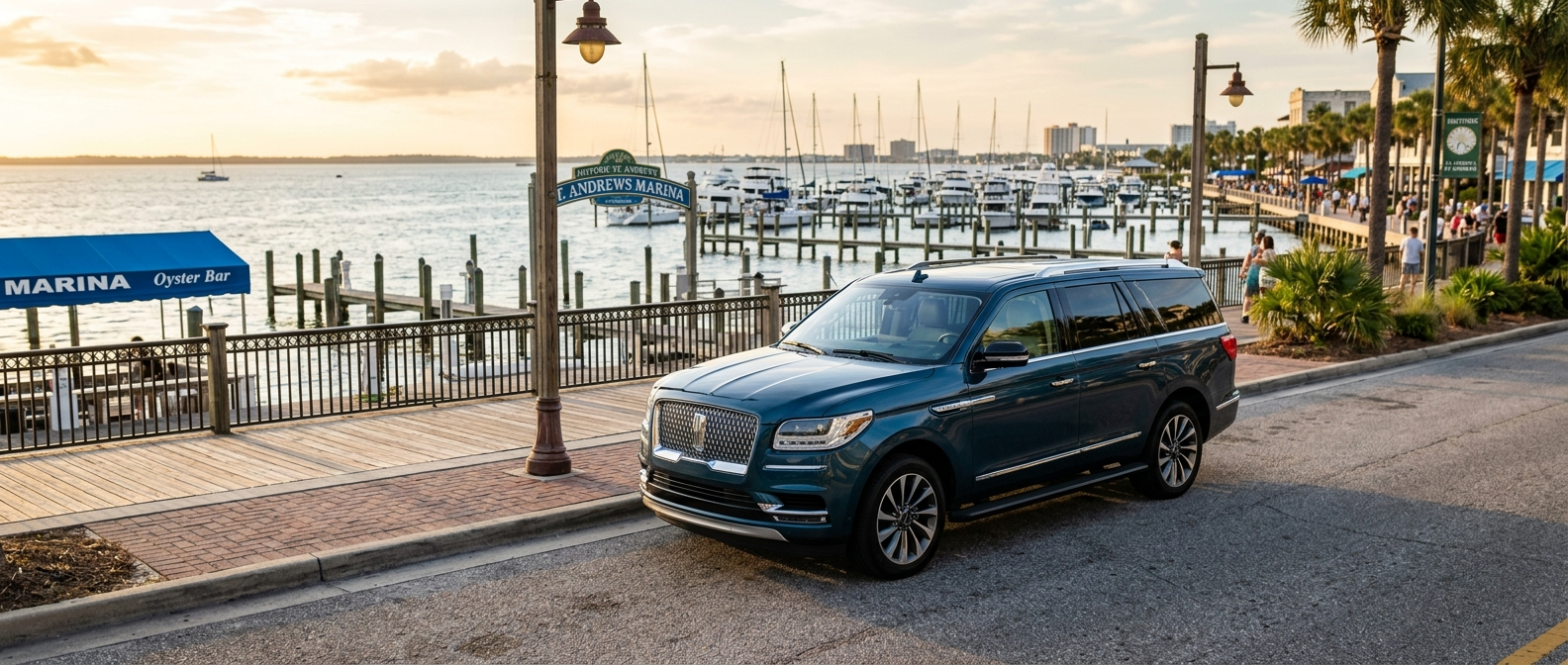
Weighing a 2026 Lincoln Navigator L near the marina district in Historic St. Andrews? Here's the short version. Towing and mileage decide it more than payment math does.
The short version
- The 2026 Navigator L is available in three trims (Premiere, Reserve, Black Label), all with a twin-turbo V6, 440 hp, and 4WD standard.
- Leasing suits a buyer who drives under roughly 12,000 miles a year, doesn't tow regularly, and wants the new 48-inch panoramic display refreshed every three years.
- Buying suits a buyer who tows a boat or trailer with any real frequency, drives the Gulf Coast corridors heavily, or plans to hold the vehicle beyond six years.
- The re-introduced 2026 Premiere trim creates a lease entry point that didn't exist on last year's lineup.
- Neither choice is wrong. The question is which profile fits your actual use.
What's the Real Difference Between Buying and Leasing a Navigator L?
Leasing means you pay for the vehicle's depreciation across the term and then hand it back or buy it out, while buying means you're building equity in an asset you eventually own outright, and both are defensible, but at this level the deciding factor turns out to be the Navigator L itself rather than the textbook split. The textbook version stops there. What it leaves out for a vehicle at this price is that the Navigator L's specific numbers (its 8,700-pound tow rating and 121.6 cubic feet of cargo space behind the first row) are the variables that actually tip the math.
| Decision Factor | Leasing | Buying |
|---|---|---|
| Hold time | 2-3 years | 5+ years |
| Annual mileage | Under ~12,000 | Higher or unpredictable |
| Regular towing | Complicates end-of-term | No end-of-term concern |
| Upfront cash | Lower (often) | Higher |
| Equity at end | None | Growing asset |
| Technology refresh | Automatic every term | Your choice, your timeline |
| Early exit | Difficult and costly | More flexibility |
| Business use deduction | Lease payments may be deductible | Section 179 may apply |
The single factor our team watches in this conversation: if a boat trailer or any regular tow is in the picture, buying removes the end-of-term wear ambiguity that leasing cannot.
Does Towing Change the Buying vs. Leasing Equation for the Navigator L?
Towing does change the equation, and it's the piece most generic buy-versus-lease guides never reach, because the 2026 Navigator L is rated to tow up to 8,700 pounds when properly equipped (8,400 pounds on models spec'd with 24-inch wheels), and every bit of that capability stays intact under a lease. For a family hauling a center-console or a loaded flatboat trailer out of the St. Andrews marina, that's a working number that means something. Historic St. Andrews sits on the north shore of St. Andrews Bay.
What changes is the end-of-term picture. Lease agreements define acceptable wear, and sustained towing puts measurable stress on hitch components, transmission cooling systems, and tires in ways a standard wear-and-tear clause may not accommodate cleanly. The conversation to have before you structure a lease around regular towing is a detailed one, and it belongs in our finance office, not in a general guide. For buyers who haul with any consistency, ownership simply takes that variable off the table.
If the Navigator L is mainly a family hauler and weekend runabout with no trailer in the picture, the towing question fades a long way down the list. Now you've got a strong lease candidate.
Worth knowing: The Panhandle's salt-air environment is hard on exposed tow components regardless of ownership structure. It's worth asking about corrosion protection on the hitch receiver whether you buy or lease.
How Does Mileage Shape the Decision on the Gulf Coast Corridor?
Mileage shapes this decision as much as towing does, and it's the second variable Panama City and Historic St. Andrews buyers need to look at squarely, because the miles pile up faster than you'd guess once you're running the coastal corridors on what a lease treats as a fixed annual budget. The Lincoln Aviator suits an urban or short-corridor profile well, but if you're running US-98 toward Panama City Beach on the regular, heading north on US-231 to Marianna, or making the run east toward the 30A communities and back, miles accumulate fast on a standard 12,000-mile annual lease allotment.
Standard lease terms typically run 10,000 to 15,000 miles per year. Go over and you'll pay a per-mile overage charge at lease return. On a full-size SUV with a buyer profile built around long coastal and inland runs, that overage risk is real, and buyers who track their annual mileage and find they're consistently over the Gulf Coast corridor average should run the per-mile math before signing.
Buying sidesteps that concern. The vehicle is yours, and the odometer is your business alone.
The 2026 Premiere Trim Reopens the Lease Conversation
For 2026 there's a change worth knowing about, because Lincoln put the Premiere trim back on the Navigator L lineup after it sat out 2025, and that lowers the entry point relative to last year while opening a lease-entry position in the range that wasn't there before.
Every 2026 Navigator L (including the Premiere) comes standard with the Lincoln Connectivity Package, which folds in 5G integration, a dedicated Wi-Fi hotspot, and Google Assistant hands-free access. The 48-inch panoramic display is standard across trims. BlueCruise hands-free semi-autonomous highway driving is standard too, though keeping it active requires an ongoing subscription.
The Reserve adds the 28-speaker Revel Ultima 3D audio system, the Lincoln Rejuvenate ambient scent-and-visual system, a Panoramic Vista Roof, and power-deployable running boards. The Black Label steps up to 30-way Perfect Position front seats, second-row Power Tailored Seats, and heated third-row seating.
For a buyer who genuinely wants the 48-inch display and the full Connectivity suite refreshed every three years as the technology evolves, the Premiere re-entry makes that argument more accessible than it was on the 2025 lineup.
Team observation: The 48-inch panoramic display is one reason we see buyers coming out of other premium vehicles lean toward a lease on this generation. A 36-month term lets you revisit that call at the end rather than carrying a platform for seven years while the digital experience ages around you. It's a legitimate consideration at this price point, and it has nothing to do with whether you can afford the vehicle.
So Which Should You Pick: Buying or Leasing the Navigator L?
Which one you pick comes down to your profile rather than any blanket recommendation, so before you look at a single figure, sort yourself into how you'll actually use the vehicle, because the mileage you drive and the trailer you may or may not pull will settle this faster than any pitch we could give you. We frame it like this.
Lease the 2026 Navigator L if:
- You drive fewer than 12,000 miles a year and are disciplined about it.
- You have no regular towing use (no boat, trailer, or frequent tow).
- You want the display and technology refreshed at the end of every three-year term.
- Predictable costs matter more to you than equity.
Buy the 2026 Navigator L if:
- You tow regularly. Full stop. Ownership removes the end-of-term wear conversation.
- You drive the long Gulf Coast corridors often and expect to exceed lease mileage allotments.
- You plan to hold the vehicle for six years or more. Buying typically becomes the stronger financial move once you're well beyond the three-year mark.
- You have a business use case that benefits from a Section 179 deduction on a vehicle over 6,000 lbs GVW. (That's a conversation for your tax advisor, not us, but the Navigator L qualifies on weight.)
The honest concession is that leasing isn't the financially rational path if you hold a vehicle long-term, since you'll pay for the vehicle's depreciation across multiple lease cycles without building any equity. For the buyer who genuinely cycles vehicles every three years and values the technology refresh, though, it isn't an irrational one either.
Browse our current availability and current specials, then come talk to us. The Navigator L sits on our lot, and it's worth standing in front of before you commit.
See Current Navigator Specials
Frequently Asked Questions
Can I use a leased Navigator L to tow my boat?
The 2026 Navigator L is rated to tow up to 8,700 pounds when properly equipped, and that capability is fully available under a lease agreement. The question isn't whether you can tow; it's what happens at lease return, because sustained towing generates measurable wear on hitch, transmission cooling, and tire components that standard lease wear-and-tear clauses may treat differently depending on the contract language. Before you structure a lease around regular towing, have that specific conversation with our finance team so you understand your end-of-term exposure. Buyers who tow with any regularity often find that ownership takes that variable off the table.
What happens if I go over my mileage limit on a Navigator L lease?
You'll pay a per-mile overage fee at lease return, and on a vehicle at this price point those fees add up fast. Standard lease terms typically offer 10,000, 12,000, or 15,000 annual miles. If you're running the Gulf Coast corridor (US-98, the Hathaway Bridge run, and back), track your annual mileage before you sign. Buyers who know they're high-mileage drivers often find that the total cost of a lease plus overages compares unfavorably to financing once the real numbers are on paper, and our finance team can model both scenarios for you.
Categories:
Social