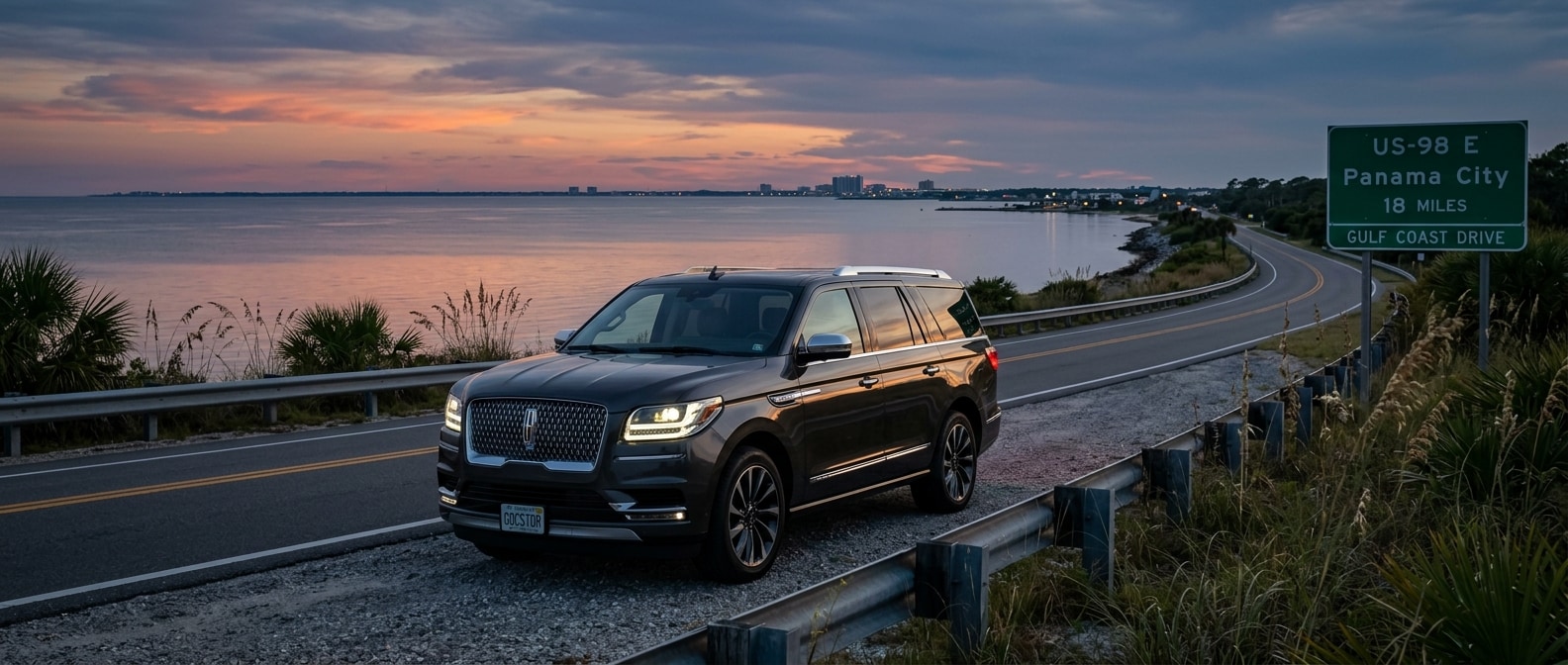
Forty-five minutes on US-98 separates Port St. Joe from West 15th Street in Panama City, and there's open water off to your left for most of it. A full family. A long weekend's worth of gear, and nobody arguing about the back seat. The 2026 Navigator L was built for that situation, and it's where the question of which trim to choose stops being abstract.
Before we go further, two numbers carry the argument. The Navigator L earns its keep through the extra 14.5 cubic feet of cargo space behind the third row and a 27-gallon fuel tank that handles a Panhandle round trip without a fuel stop. The honest trade-off is that 221.9 inches of overall length asks for a wider parking arc than you'd need in the standard-wheelbase Navigator. If your life is mostly open highway and you fill all three rows, the L makes sense. If you run solo or with one other person on short errands, it's more vehicle than you need.
Everything below is specific to the 2026 model year, and it's verified against Lincoln's published specifications.
What Do You Actually Get at Each Trim?
All three 2026 Navigator L trims share one foundation, a twin-turbocharged 3.5-liter V6 producing 440 horsepower and 510 lb-ft of torque, a 10-speed SelectShift automatic, and standard four-wheel drive, so the mechanical story never changes as you move up the range. Lincoln's Co-Pilot360 Drive 2.0 safety suite comes standard across the lineup. What changes between Premiere, Reserve, and Black Label is who rides in what comfort, and what fills the cabin.
| Trim | What You Actually Get | Who It's For |
|---|---|---|
| Premiere L | 48-inch panoramic display, 14-speaker audio, Lincoln Soft Touch upholstery, third-row seating for 8, standard Co-Pilot360 Drive 2.0, power folding third row | Families who want the full L cargo advantage without stepping into leather territory; bench-seat second row only |
| Reserve L | Genuine leather seating, 28-speaker Revel Ultima 3D Audio, Panoramic Vista Roof with power sunshade, Lincoln Rejuvenate wellness system, Digital Scent, power-deployable running boards, available second-row captain's chairs | The family running the coast regularly who wants a quieter cabin and real material upgrades for every passenger |
| Black Label L | All Reserve features plus curated interior themes (Atmospheric, Enlighten, or Invitation) with Opulence leather, bespoke trim materials, and the highest level of interior finish Lincoln produces | Buyers for whom the interior experience is the point, not just the cargo |
The one feature only Reserve and above can unlock is second-row captain's chairs. If you're hauling three car seats or need genuine second-row access to the third row without gymnastics, that single spec decides the question.
View Current Navigator L Specials
The L's Real Argument Is the Cargo Behind Row Three
The L's case rests almost entirely on what fits behind the third row, where a standard-wheelbase 2026 Navigator carries 22.9 cubic feet with all three rows up and the L carries 37.4, a gap wide enough to decide whether the golf bags ride inside or on a roof rack. None of that is a rounding difference. In practical terms, golf bags for four, a soft-sided cooler, and a bag each fit behind row three in the L when they'd force a roof rack or a second vehicle in the standard Navigator.
The 27-gallon fuel tank is the other number that matters for Panhandle driving. The EPA rates the Navigator L at 15 city and 22 highway, with a 17 combined figure. At 22 highway miles per gallon, that tank carries nearly 600 highway miles between fill-ups. Port St. Joe to Panama City and back runs roughly 90 miles, so you're making multiple round trips before the gauge becomes a concern, and that's with real cargo aboard.
Worth knowing: the L's 43.9-foot turning diameter (Lincoln's published figure) is meaningfully wider than a standard-size crossover. Tight parking garages and compact downtown lots require planning. The US-98 corridor and the streets around West 15th Street in Panama City accommodate it without drama, but it's the one thing to consider if downtown parking is part of your weekly routine.
The Split Gate tailgate is exclusive to Lincoln in this segment. Its top panel opens like a traditional liftgate, and the bottom panel drops to create a loading shelf. Loading the cargo area of a 221.9-inch vehicle at the back of a busy parking lot is a good deal easier with a stable shelf to set things on first.
Compare the standard-wheelbase Navigator
Pros and Cons of Choosing the L Over the Standard Navigator
| Pros | Cons |
|---|---|
| 14.5 cubic feet more cargo behind row 3 (37.4 vs. 22.9 cu ft) | 221.9-inch overall length requires more maneuvering in tight lots |
| 27-gallon fuel tank vs. 23-gallon on standard (more range between stops) | Turning diameter of 43.9 feet is wider than most crossovers |
| Identical legroom and headroom to standard (no passenger compromise) | Larger footprint adds weight (approximately 6,002 lb curb weight) |
| Same 8,700-lb tow rating when properly equipped | Not the right choice for solo or two-person daily driving |
| Split Gate tailgate makes cargo loading more practical |
Which Trim Makes Sense for the Coast Run
The Reserve L is where the L's coast-run advantages come together, and if you're weighing all three trims, it's the one worth sitting in first for the audio, the roof, and the material upgrades that reach every passenger. Its 28-speaker Revel Ultima 3D Audio doesn't just sound different, it changes what a 45-minute stretch of US-98 feels like to the people in rows two and three. The Panoramic Vista Roof opens the cabin in a way that makes a loaded vehicle feel less closed-in. And Lincoln Rejuvenate, easy to dismiss on paper, is the kind of feature someone actually uses after a long day at the coast before the drive home. Here on the Gulf Coast, summer heat load is where the power sunshade over that glass earns attention, since a loaded three-row cabin holds the afternoon well after you've parked in the sun.
Premiere L makes genuine sense for buyers who want the cargo advantage of the L body and plan to spend that budget elsewhere, and its Lincoln-grade upholstery never reads as a compromise. What you're giving up is the audio and the roof, not the ride or the space.
Black Label is for the buyer who already knows. The interior themes are hand-curated, the materials sit a level above Reserve, and if the cabin is where you spend your mornings and evenings, the difference is perceptible. We don't pitch it as status. We describe what's inside.
The Lincoln Aviator is worth a moment's thought if the L's size genuinely exceeds what your driving involves. It's a three-row midsize that carries seven passengers and doesn't ask for a wide-arc turn. The honest answer is simple. If you fill three rows and haul real cargo, the Navigator L is the right vehicle, and if you only occasionally use row three, the Aviator may be the more precise fit.
Frequently Asked Questions
Does the 2026 Lincoln Navigator L come in all three trim levels?
Yes. The 2026 Navigator L is available in Premiere, Reserve, and Black Label configurations. Each shares the same 440-horsepower twin-turbocharged V6, standard four-wheel drive, and 10-speed automatic transmission.
Is the Navigator L too large for everyday driving near Panama City?
It depends on where you park most often. The 2026 Navigator L is 221.9 inches long with a published turning diameter of 43.9 feet. The corridors around West 15th Street in Panama City handle it without difficulty, but compact urban garages require planning.
What makes the Reserve L different from the Premiere L?
The Reserve L adds genuine leather seating, a 28-speaker Revel Ultima 3D Audio system, a power Panoramic Vista Roof, Lincoln Rejuvenate wellness features, and available second-row captain's chairs. These upgrades enhance comfort and cabin experience without changing the cargo or engine specifications.
Categories:
Social