
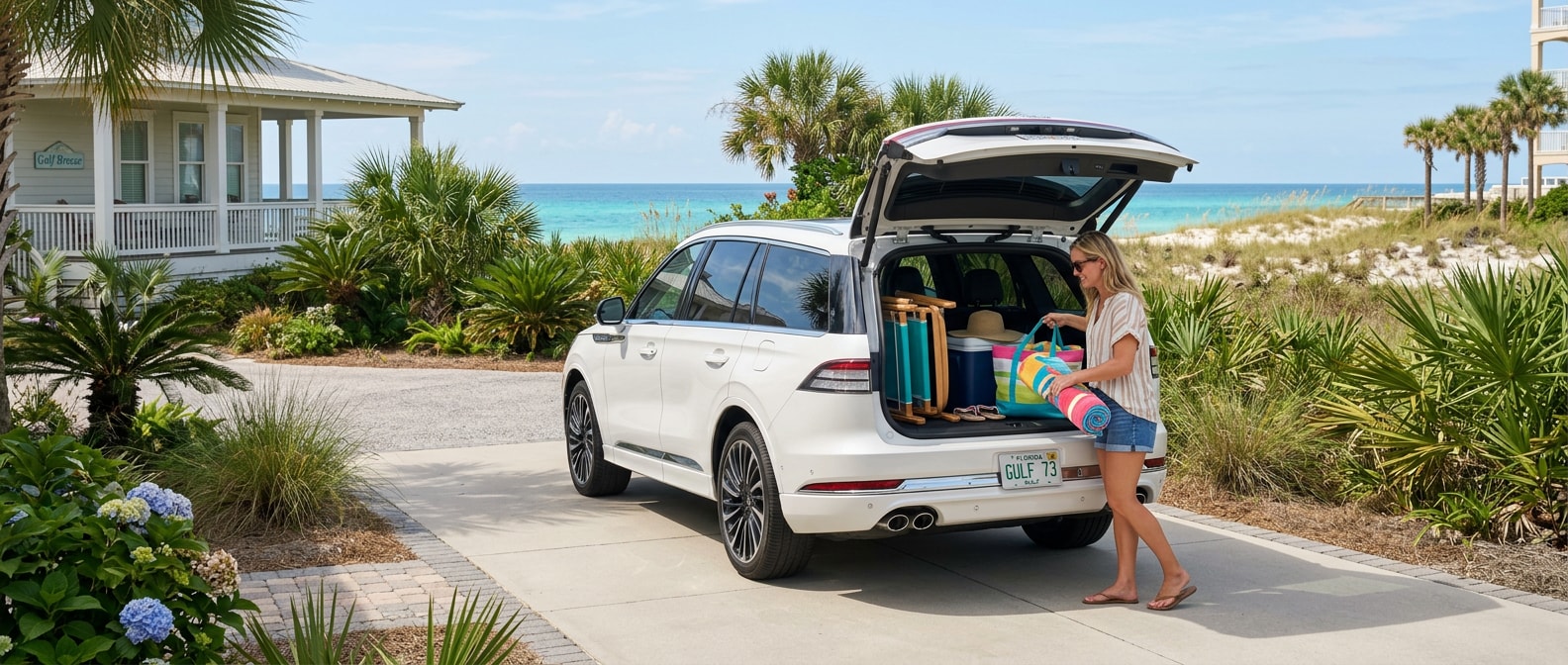
The window between "I'm buying it" and "I'm driving it home" is short. Most people also stop thinking clearly right about then. We built this checklist for that window.
The 2026 Lincoln Aviator is a genuinely capable three-row luxury SUV, and we want every buyer who leaves our lot on West 15th Street to feel certain about the configuration and the small details before the keys change hands. Certainty like that doesn't come from a brochure. It comes from a deliberate walk-through, and a few questions answered before you sign.
What Goes on the Checklist?
Six items make up this list, and each one ties to either a specific Aviator spec or a real condition in Bay County that makes it matter more here than it would in, say, Tulsa, so none of them is filler. Read them once now, then again on delivery day.
Your 2026 Lincoln Aviator Pre-Purchase Checklist
- [ ] Confirm your trim and drivetrain. Premiere, Reserve, or Black Label? RWD or AWD? The decision changes your driving position in this market.
- [ ] Verify the towing package is installed. It's standard on every 2026 trim, but confirm it's documented and the wiring harness is intact.
- [ ] Run the VIN for open recalls. The 2026 Aviator has three active NHTSA recall campaigns as of publication. Confirm all have been completed before delivery.
- [ ] Conduct the coastal walk-around. Check panel gaps, rubber seals, and the undercarriage finish on any demo or dealer-driven unit. Salt air works fast along US-98.
- [ ] Test the PowerFold third-row before you leave. Press the button. Watch all the way through the fold cycle. It should be silent, flat, and complete.
- [ ] Confirm the fuel recommendation. The 2026 Aviator runs on regular unleaded. Know it, tell your household, and don't let anyone put premium in it out of habit.
Why Each Item Matters Here
Trim and drivetrain: the RWD question Florida buyers always ask
Florida never sees snow, so skipping all-wheel drive can feel like the obvious move, though our flat, hot, wet market from June through November makes the AWD question worth a second and more careful look. RWD on a dry Panhandle highway is composed and efficient. The EPA rates the 2026 Aviator RWD at 18 city and 25 highway on regular fuel. AWD drops city economy to 17 but holds 25 highway. In this climate, the argument for AWD is about water rather than ice. Picture four-wheel pull in a sudden downpour on US-98 when the lane markings vanish under standing water. Decide that on paper, not in the rain.
Our finance team can walk you through the package-by-package cost difference between Premiere AWD and Reserve, which is a comparison worth having before you arrive. Three trims exist. The lineup runs Premiere, Reserve, and Black Label. Reserve is where the quad-zone climate control and the Revel audio system arrive. Black Label comes standard with AWD.
The honest tradeoff on AWD in this market is a simple one. It costs a bit of fuel economy and a meaningful amount upfront, and it earns its keep about a dozen times a year in late-afternoon storms. You decide what that's worth.
The towing package: it's there, but check the documentation
Every 2026 Aviator leaves the factory with the Class III Trailer Tow Package as standard equipment. That means a factory-installed hitch receiver and a maximum towing rating of 5,000 pounds when properly equipped. The Navigator lineup tops that significantly if you're hauling a larger boat, but for a center-console or a couple of personal watercraft, the Aviator's rating covers most of what Bay County families put behind a tow vehicle on a weekend morning.
What we ask buyers to check has less to do with whether the package is listed on the window sticker and more to do with whether the wiring harness connector at the hitch is clean, seated correctly, and tested. On a coastal demo unit that's done a few hundred lot miles in salt air, that connector deserves a look. Ask a service advisor to pull it and confirm; the whole check takes two minutes.
Browse our current Aviator inventory to see which units are stock and which have been driven on the property before you make the trip in.
Worth knowing: Lincoln specifies a tongue weight limit of 500 pounds (10 percent of the 5,000-pound gross trailer weight). Load your trailer accordingly. Front-heavy loads cause sway; rear-heavy loads take down rear-end stability. Both come down to how the driver loads the trailer rather than to any Aviator limitation.
| Checklist Item | Why It Matters Here |
|---|---|
| RWD vs. AWD decision | Wet-season downpours on flat coastal roads; no ice, but real hydroplaning risk |
| Towing package documentation | Boat country; hitch connector corrosion visible early on coastal demo units |
| Open NHTSA recalls | 2026 Aviator has 3 active campaigns; verify all are resolved at delivery |
| Coastal walk-around | Salt air and high humidity accelerate corrosion on seals, gaps, and undercarriage |
| PowerFold third-row test | 16.5 cubic feet behind row three; fold cycle should complete silently and fully flat |
| Fuel type confirmation | EPA-rated on regular unleaded (not premium); matters for the whole household |
Open recalls: a five-minute step most buyers skip
NHTSA lists three recall campaigns on the 2026 Lincoln Aviator as of this writing. We complete open recalls before delivery as a standard step. Ask us anyway. Have us show you the closed-recall documentation by VIN, and treat it as your permanent record. Keep it in the glovebox alongside the owner's manual. It takes about five minutes to pull up, and it closes a question that can otherwise sit in the back of your mind for years.
The recall record is public at nhtsa.gov. You can run the VIN yourself before you arrive if you want to know exactly what was addressed.
The coastal walk-around: not optional in this zip code
Gulf Coast salt air does real mechanical work, and we treat it as fact rather than a talking point. Coastal environments expose brake hardware, suspension connectors, and rubber seals to a level of corrosion that simply doesn't apply in drier markets. For a brand-new unit that's lived on a coastal dealer lot for several weeks, a careful exterior walk is sound practice.
Walk the perimeter. Panel gaps should be even. Rubber door seals should be pliable, with no cracking or white residue at the edges. If you can get a look at the undercarriage (our service team is glad to put the unit on a lift for a five-minute check), do it. On new inventory, anything you find is our responsibility to address before delivery. The right time to find it is now.
The third row: test it loaded, not empty
The 2026 Aviator's third row folds flat from the cargo area with a button press (Lincoln calls it PowerFold, and it's one of the genuinely useful things built into this generation). What it leaves behind row three when both rows are up is 16.5 cubic feet. With all rear rows folded, Lincoln lists 77.7 cubic feet of cargo volume. The fold should be silent, fully flat, and complete in a single press. Any hesitation or grinding sound is a service conversation to have before delivery rather than after.
Test it as you'd actually use it. Walk to the back, press the button, and watch. Then fold the second row and check the flat load floor. A family loading beach gear in a Panama City Beach parking lot doesn't have time for a stuck fold mechanism.
Your Print-and-Go Recap
Take this with you to our lot, or pull it up on your phone the day you're scheduled to take delivery, so nothing on the list waits until you're already at the desk.
- Choose your trim and drivetrain before you arrive. Reserve AWD is a configuration that fits this market well, but the Premiere RWD is the right answer if your trailer is small and your budget matters.
- Ask for the VIN recall report at handoff. Confirm all three 2026 campaigns are closed.
- Request the towing package documentation and a quick look at the hitch connector.
- Walk the full exterior with a service advisor. Seals, gaps, undercarriage if you have time.
- Run the PowerFold cycle at the cargo door. Both rows. All the way through.
- Check the fuel door label. It should read regular unleaded. The EPA rates the 2026 Aviator's 3.0-liter twin-turbo V6 at 18 city and 25 highway in RWD configuration on regular fuel. Keep that spec (it matters when you fill up for the first time).
When you're ready, get a trade-in estimate on what you're currently driving. A clean appraisal before you arrive means the conversation at the desk is one step shorter, maybe two.
By the Bay Lincoln Team | September 2026
Frequently Asked Questions
Does the 2026 Lincoln Aviator require premium fuel?
No. Lincoln specifies regular unleaded for the 2026 Aviator's 3.0-liter twin-turbocharged V6. It's among the few engines in the three-row luxury segment that doesn't call for premium. The EPA rates fuel economy at 18 city and 25 highway for the RWD configuration on regular fuel. You don't need to use premium, and doing so routinely offers no performance benefit over the manufacturer's recommendation.
Is all-wheel drive worth it for Bay County, Florida drivers?
The Panhandle doesn't get ice or snow, so the usual cold-climate argument for AWD doesn't apply here. The relevant case for AWD in this market is the Gulf Coast wet season from June through November, when heavy afternoon downpours can leave standing water on flat coastal roads quickly. AWD provides additional traction confidence in those conditions. The trade-off is a one-MPG drop in city fuel economy (17 versus 18 city, EPA-estimated) and a higher upfront cost, since AWD is a package option on Premiere and Reserve trims and standard only on Black Label. For drivers who tow occasionally and stay close to the coast, AWD earns its keep. For drivers whose primary use is dry-weather highway commuting, RWD is capable and more efficient.
Categories:
Social