
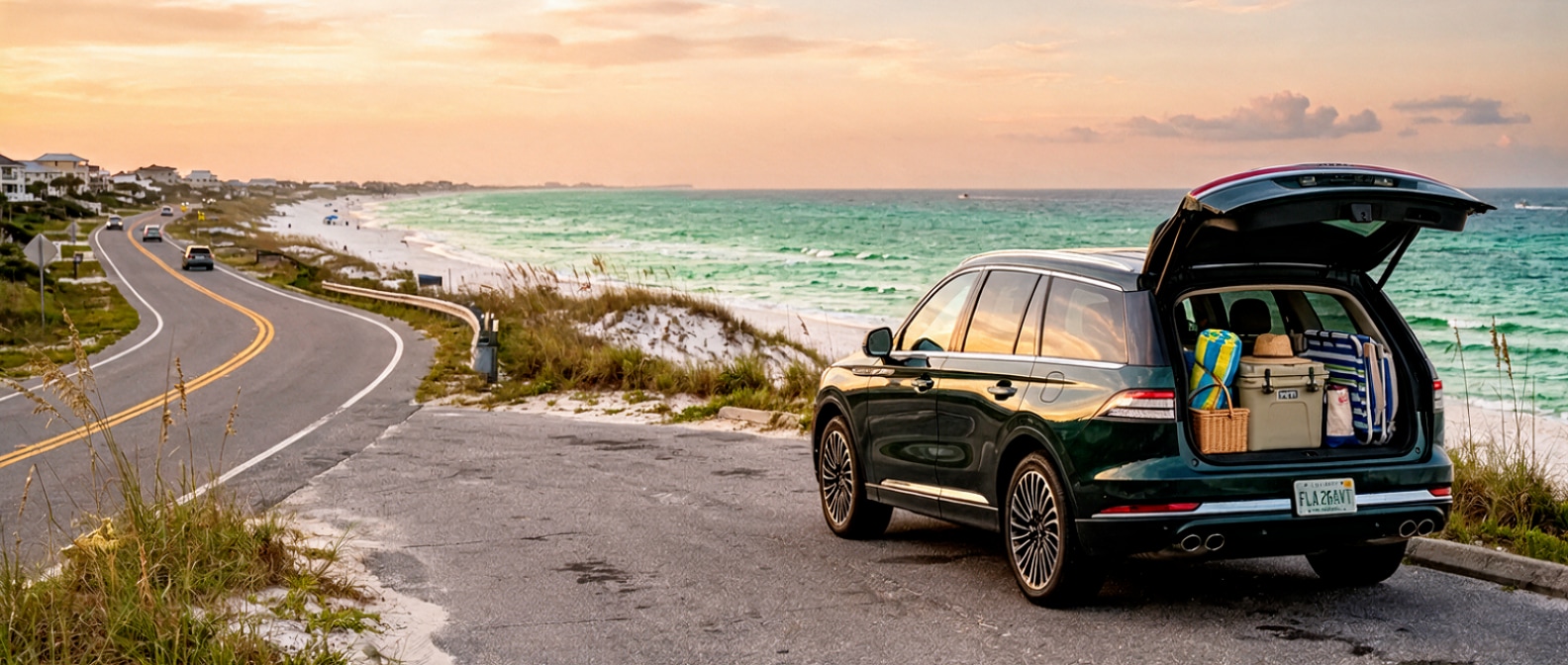
Yes, with one caveat we won't dance around. The Lincoln Aviator fits this Panhandle corridor well for families who need three rows and quiet cabin comfort on the US 98 run into Panama City and north up US 231. The caveat is simple. That third row works for children, not comfortably for adult passengers, and knowing that upfront shapes whether the Aviator is the right call for your family.
What Makes the Aviator Work on the US 98 and US 231 Corridor?
The Aviator earns its place on this corridor for three reasons that track with what families actually weigh before a Panhandle trip, and they come down to range, comfort, and whether the cargo situation stays practical once the beach gear is loaded. The Aviator answers all three specifically.
Range first. Lincoln's 20.2-gallon fuel tank paired with the EPA's estimated 25 miles per gallon on the highway (that figure holds for both RWD and AWD configurations) works out to a theoretical highway range of around 505 miles on a full tank. The road distance from Mexico Beach west on US 98 to the US 231 terminus in downtown Panama City runs about 24 miles. You're not stopping for fuel on this run. You're making it with room to spare. That matters on a late afternoon return, when the last thing anyone wants is a gas station detour with tired kids in the back.
Cabin quiet on a hot afternoon. The Aviator uses active noise control technology that reads and counteracts cabin sound continuously. US 98 through the Callaway and Springfield stretch isn't a glass-smooth interstate; it's a working Gulf Coast two-lane with traffic lights, concrete seams, and summer heat shimmer. What we notice about the Aviator on this type of road is that the cabin stays composed when the pavement does not. Wind and road noise are genuinely well-managed for a three-row SUV in this segment.
Cargo with the third row up. Lincoln lists 19.2 cubic feet of cargo space behind the third row, which covers a family's beach bag, a cooler, and a few towels. Fold that row flat with the PowerFold button at the cargo area and you're at 39.9 cubic feet. The full fold to maximum (just over 75 cubic feet) removes seating for the back two rows entirely. A family of five with a car seat, beach chairs, and a week's worth of gear will find the layout workable on a day trip. A full-week haul gets tight.
| Trip Scenario | Third Row | Cargo | Fit? |
|---|---|---|---|
| Two adults, two kids, day trip to Mexico Beach | Up | 19.2 cu ft | Good |
| Two adults, three kids, week-long Panhandle run | Up | 19.2 cu ft | Workable; pack light |
| Adults filling all three rows | Up | 19.2 cu ft | Cramped third row (see below) |
| Two adults, gear-heavy weekend, no third-row riders | Folded | 39.9 cu ft | Comfortable |
| Solo adults or couple, full gear hauling | Flat | 75+ cu ft | No seating compromise needed |
Browse our current Aviator inventory
Is the Third Row Honest Enough for a Family?
The third row suits children well and struggles with adults, and we'd rather you hear that from us before the drive than discover it on US 98 with a grown passenger folded into the back of a family SUV that was never designed to carry one there comfortably. The Aviator's third row has 29.2 inches of legroom and 36.9 inches of headroom. For children, those numbers work fine. For adults making even the 24-mile US 98 run from Mexico Beach into Panama City, it's a genuine squeeze. You'll hear reviewers hedge this. We won't. If you have two adults who need the third row regularly, the Lincoln Navigator is the better answer. The Aviator's third row is designed for the family where adults sit in rows one and two and children take the back.
What the Aviator does do well back there: Lincoln includes climate vents and USB charging ports, so the kids who occupy it on the way home from Mexico Beach aren't cooking or arguing about a dead phone. Those details matter on a late August afternoon in the Panhandle, when the ambient temperature is pushing into the mid-nineties and the air conditioning has to reach the furthest seat.
The six-passenger layout with second-row captain's chairs also gives you a pass-through to the third row, so a parent can hand something back without stopping the vehicle. That's not a small thing when you have a car seat in row two and a seven-year-old in row three asking for a snack at the Parker interchange.
- The EPA rates AWD Aviator highway fuel economy at 25 mpg, same as RWD
- Lincoln lists 19.2 cubic feet of cargo space behind the third row when it is up
- The PowerFold third-row button works from the cargo area, not just the seat itself
- Active noise control runs continuously, not just at certain speeds
- The twin-turbo 3.0-liter V6 produces 415 lb-ft of torque, which matters when you leave Mexico Beach on a hot afternoon with a full load
What Is the US 98 and US 231 Drive Actually Like in an Aviator?
The drive has two distinct personalities and the Aviator suits each differently, with the northern US 231 legs rewarding its quiet highway manners and the southern Panama City stretch, thick with signal lights and stop-and-go, being where fuel economy and the driver-assist tech actually earn their keep. US 231 in Florida runs 52 miles from its southern terminus at downtown Panama City north through Youngstown, Fountain, and Cottondale to I-10 and eventually the Alabama state line. The southern leg, through the Panama City urban area, throws signal lights, suburban commercial corridors, and the kind of stop-and-go that drops your real-world fuel economy noticeably below the highway figure.
The EPA puts city fuel economy at 18 mpg for RWD and 17 mpg for AWD. Plan against that number on the Panama City side of the run.
The Mexico Beach end is all US 98, flat and two-lane in stretches, with the Gulf sliding in and out of view as the road threads through coastal communities. The Aviator makes it a pleasant drive precisely because the suspension is tuned for compliance rather than sport. You feel the road textures without getting jarred by them.
Does the stop-and-go near Tyndall wear on you? It can, and the corridor passes through areas near Tyndall Air Force Base where traffic can bunch at certain times of day. The Aviator's Lincoln Co-Pilot360 Drive 2.0 system includes adaptive cruise control and Pre-Collision Assist with automatic emergency braking. Those features won't make stop-and-go traffic enjoyable, but they cut the fatigue of it. Think of driver-assist technology the right way, as a fatigue-management aid and not an autonomous driving system.
Explore Aviator financing options
The two-row Nautilus carries the same quiet cabin character in a smaller, easier-to-park footprint if three rows aren't a requirement for your household.
Which Family Does the Aviator Actually Fit?
The Aviator is the right choice when children rather than adults occupy the third row, when the priority is a composed, quiet highway cabin over maximum cargo volume, and when the family wants a three-row that doesn't demand navigator-level parking patience on Mexico Beach's narrow beach access roads. Those are the households it was built around.
The Aviator stops being the right choice if your family regularly fills all three rows with adults, if you're towing anything over 5,000 pounds (properly equipped maximum), or if cargo volume for a full week of gear is the primary requirement. Those scenarios belong in the Navigator or Navigator L.
For the established Panhandle household making regular runs between Mexico Beach and Panama City, the Aviator's proportions are a deliberate middle ground. It fits a standard garage. It handles the Tyndall Parkway traffic without feeling ungainly. And it delivers the calm interior that makes a 45-minute US 98 drive feel shorter than it is.
Frequently Asked Questions
Does the Lincoln Aviator have enough cargo space for a beach trip from Mexico Beach?
With the third row occupied, Lincoln lists 19.2 cubic feet of cargo space behind it in the Aviator. That's enough for a cooler, beach bag, and towels for a family of five on a day trip. Fold the third row flat using the PowerFold button at the cargo area and cargo volume grows to 39.9 cubic feet.
What is the fuel range on the Lincoln Aviator for Panhandle highway driving?
The 2026 Lincoln Aviator carries a 20.2-gallon fuel tank. The EPA estimates 25 miles per gallon on the highway for both RWD and AWD configurations. That works out to approximately 505 miles of estimated highway range on a full tank, which is more than enough to handle the US 98 and US 231 corridor multiple times between fill-ups.
Is the Aviator better than the Navigator for this type of Panhandle trip?
It depends on your family's composition. If adults need comfortable third-row seating, the Navigator is the better fit. If children occupy the third row and adults are in rows one and two, the Aviator handles the Mexico Beach to US 231 run very well and is easier to maneuver and park in coastal areas.