
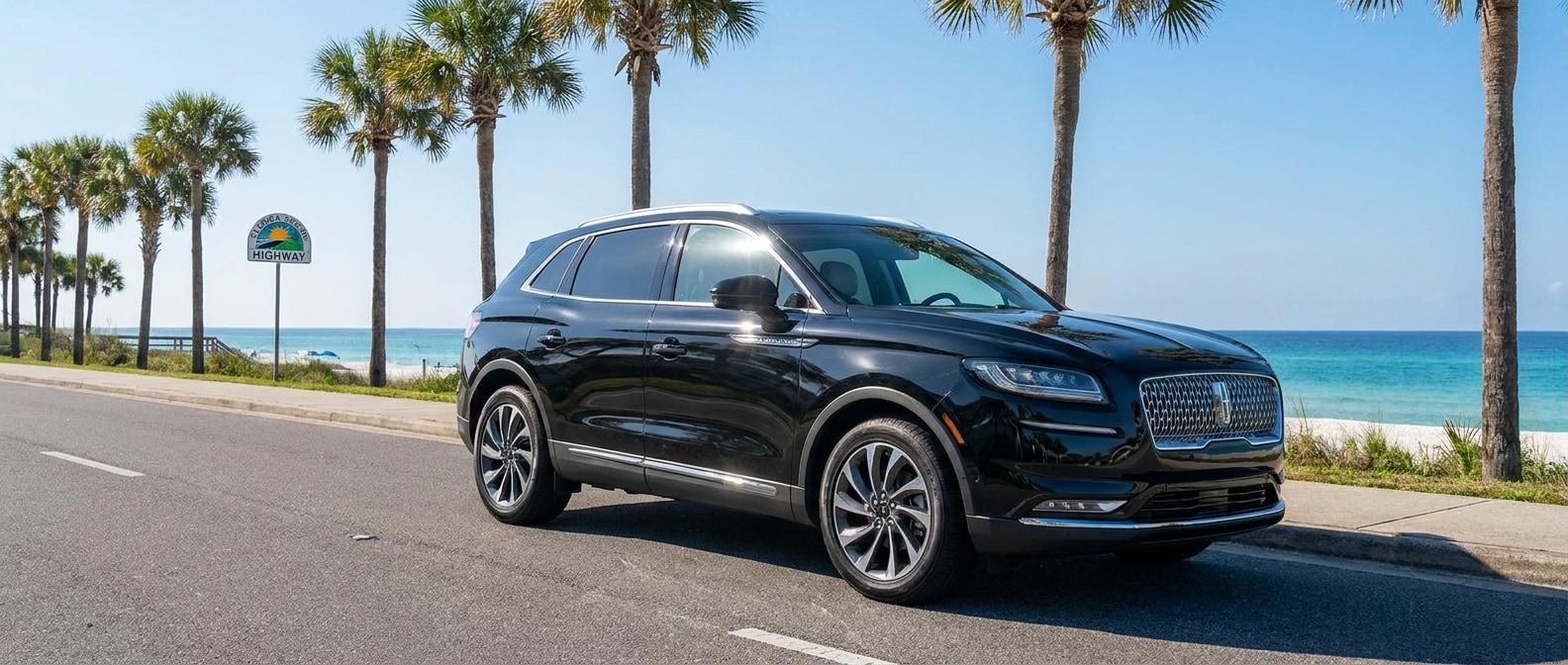
Both trims are genuinely good, and the thing that decides it isn't prestige. How you use US-98 every day is the honest answer here.
The 2026 Lincoln Nautilus arrives with AWD standard on every trim, BlueCruise 1.5 included across the board, and a cabin that keeps road noise contained on the longer stretches. What the Premiere and Reserve actually disagree on comes down to two things, ride composure over uneven pavement and the cabin technology you want around you on a 20-minute daily run. Each one lands somewhere different, and we'll walk you through where.
- Both Premiere and Reserve share the same 250 hp turbocharged engine, standard AWD, and BlueCruise 1.5 hands-free highway tech, the powertrain argument is a tie.
- The Reserve adds an adaptive suspension, which makes a real difference on the patched pavement sections of US-98 through Callaway.
- The Premiere's 360-degree surround camera and automated parking system (available in the Premiere II package) directly addresses tight campus-area parking near GCSC.
- Choose the Premiere if you want the parking and camera tech in a leaner package. Choose the Reserve if the daily highway ride and the cabin quiet are what you'll feel every morning.
- Neither trim has a cargo shortfall for typical Panhandle errand loads: 36.4 cu ft behind the second row on the Premiere, 35.2 on the Reserve.
What's the Real Difference Between These Two Trims?
The Premiere is more capable than it looks on paper, and the Reserve is more specific than it sounds, so neither one is the obvious winner until you know your route, and because they share the same running gear the decision comes down to feel more than numbers. Both ride on the same 2.0L turbocharged four-cylinder (250 hp, 280 lb-ft of torque) mated to an 8-speed automatic, with AWD engaged permanently. Lincoln lists the EPA fuel economy at 21 city, 29 highway, and 24 combined for the gas powertrain. The figure holds across both trims because the engine and drivetrain are identical.
What truly separates them sits in two places. The first is the Reserve's adaptive suspension, which actively adjusts damping as you move through surface changes. US-98 through Panama City and into Callaway runs stretches of older pavement with inconsistent surface prep, and that adaptive setup does measurable work on a route you drive daily. The Premiere uses a conventional suspension, well-tuned for the segment but not adjusting in real time. The second is Active Noise Control, standard on the Reserve, which layers acoustic-laminated glass on the front doors and windshield alongside the system. Day to day, the cabin simply sounds quieter at highway speeds.
The Premiere closes that gap with optional packages. The Premiere II package adds the 360-degree surround camera, front and rear parking sensors, automated park assist, and safe exit assist, so it isn't a thin entry-level vehicle. It's a genuine choice.
| Feature | Nautilus Premiere | Nautilus Reserve |
|---|---|---|
| Engine / Horsepower | 2.0L turbo I-4 / 250 hp | 2.0L turbo I-4 / 250 hp (285 hp hybrid avail.) |
| Torque | 280 lb-ft | 280 lb-ft (295 lb-ft hybrid) |
| EPA Fuel Economy (gas) | 21 city / 29 hwy / 24 combined | 21 city / 29 hwy / 24 combined |
| EPA Fuel Economy (hybrid) | Not available | 29 city / 31 hwy |
| AWD | Standard | Standard |
| BlueCruise 1.5 | Standard (4-yr trial) | Standard (4-yr trial) |
| Adaptive Suspension | Not available | Standard |
| Active Noise Control | Not standard | Standard |
| 360-Degree Camera / Park Assist | Available (Premiere II pkg) | Standard |
| Cargo (seats up / folded) | 36.4 / 71.3 cu ft | 35.2 / 68.8 cu ft |
| Wheels | 19-inch standard | 21-inch standard |
Does BlueCruise 1.5 Actually Work on This Stretch of US-98?
BlueCruise 1.5 works on the divided sections of this corridor, and yes, US-98 Tyndall Parkway through Callaway qualifies where it's divided, so the short version is that the hands-free system does engage on your daily run between Panama City and Callaway. A fair question before you commit to that commute is whether the tech really earns its place here. On those qualified stretches the Nautilus manages steering, acceleration, and braking hands-free, and BlueCruise 1.5 adds automatic lane changes the previous version didn't perform.
Browse our current Nautilus inventory to see which trim configurations are available today.
Worth saying plainly, BlueCruise is a driver-assistance system, not autonomous driving. Your attention and judgment stay in the vehicle. The system works within its qualified zones and drops out of hands-free mode when conditions require it. For a commute that crawls near campus and then opens up on the Tyndall Parkway section, the handoff between adaptive cruise in slower traffic and BlueCruise on the open highway is seamless on both trims, because the tech stack is identical between Premiere and Reserve.
Know before you buy: BlueCruise isn't the reason to choose one trim over the other. Both get it. If hands-free driving on the Callaway corridor is your primary draw, either trim delivers it.
Parking Near Campus: Where the Premiere's Optional Tech Has an Edge
Gulf Coast State College's US-98 campus sits in a dense stretch of Panama City where lots fill quickly during peak class hours and the surrounding surface streets don't give you much overflow, which is exactly where the Premiere's optional camera tech starts to matter. Tight turns into parking structures and compact lots are the scenario the Nautilus's available automated parking system was built for.
On the Premiere, the 360-degree surround camera, front and rear parking sensors, and automated park assist come through the Premiere II package. On the Reserve, that full camera suite is standard equipment. Either way you get a top-down view of the Nautilus and its surroundings in a tight spot, a practical asset when you're threading into a narrow campus-adjacent space with vehicles on both sides. On a bright Gulf morning the overhead view earns its keep; you can still read the painted lines with the sun sitting low over US-98.
We've also noticed how the 48-inch panoramic display, standard across all 2026 Nautilus trims, positions the driver information, navigation, and media zones in a single sweep that doesn't ask you to look down or across the dash while working unfamiliar surface streets. That matters on a route like the US-98 corridor, where the signal timing and turn lanes demand real attention.
View Current Nautilus Specials
So Which Trim Should You Actually Pick?
Pick the Premiere if you want the camera and parking tech in a leaner package, and pick the Reserve if the daily ride and cabin quiet are what you'll feel every morning on this corridor, because both are right answers and the choice tracks your route rather than a badge. Here's how it shakes out once you line it up against your own week.
Check our current Nautilus offers and consider your daily pattern first.
The Premiere makes the most sense if you check any of these boxes:
- Your route is mixed between stop-and-go and moderate highway speeds.
- You want the BlueCruise and camera technology without the Reserve's broader upgrade set.
- You plan to add the optional hybrid powertrain another way.
With 36.4 cubic feet of cargo space behind the second row and the full camera and park assist available in the Premiere II package, it covers the practical ground without compromise.
The Reserve makes the most sense if you spend significant time on US-98 at highway speeds and the cabin refinement really matters to you day to day. The adaptive suspension does real work on variable pavement. Active Noise Control makes a measurable difference at 65 mph. The available hybrid powertrain (285 hp combined, EPA 29 city and 31 highway) is only accessible at the Reserve and Black Label level, so if you drive enough to feel fuel economy over the course of a year, that hybrid option represents a real return.
The honest tradeoff is that the Reserve costs more and doesn't add cargo space; it actually gives up a small amount compared to the Premiere. The Premiere, for its part, doesn't compromise on safety tech or the powertrain. Neither choice is wrong. What you're deciding is whether the daily sensory difference of the adaptive suspension and the quieter cabin is worth the step up for how you drive.
The Lincoln Aviator is worth a look if three-row capability has been on your mind, but for a two-row focused on the daily Panhandle run, the Nautilus conversation starts and ends with these two trims.
Frequently Asked Questions
Does the 2026 Lincoln Nautilus Premiere come with BlueCruise 1.5?
Yes. Lincoln includes BlueCruise 1.5 as standard equipment across all 2026 Nautilus trims. Premiere, Reserve, and Black Label, with a four-year subscription included. The system enables hands-free driving on prequalified divided highway sections, including portions of US-98, and adds automatic lane-change capability that the previous version did not offer. You don't need to step up to the Reserve to access it.
Is the 2026 Nautilus Reserve hybrid available in the Panhandle, and is the fuel economy difference meaningful?
The hybrid powertrain (285 hp combined, EPA-rated 29 city and 31 highway) is available on Reserve and Black Label trims. On the gas powertrain, both Premiere and Reserve return the same EPA-estimated 24 combined mpg. The hybrid's 31 highway rating is a genuine step up for buyers who put significant miles on a daily commute along US-98. Whether that delta is meaningful depends entirely on your annual mileage. For a buyer driving 15,000 or more miles per year on highway-weighted routes, the math tends to favor the hybrid option. Our team's glad to run through the numbers with you in a straightforward conversation when you come in.