
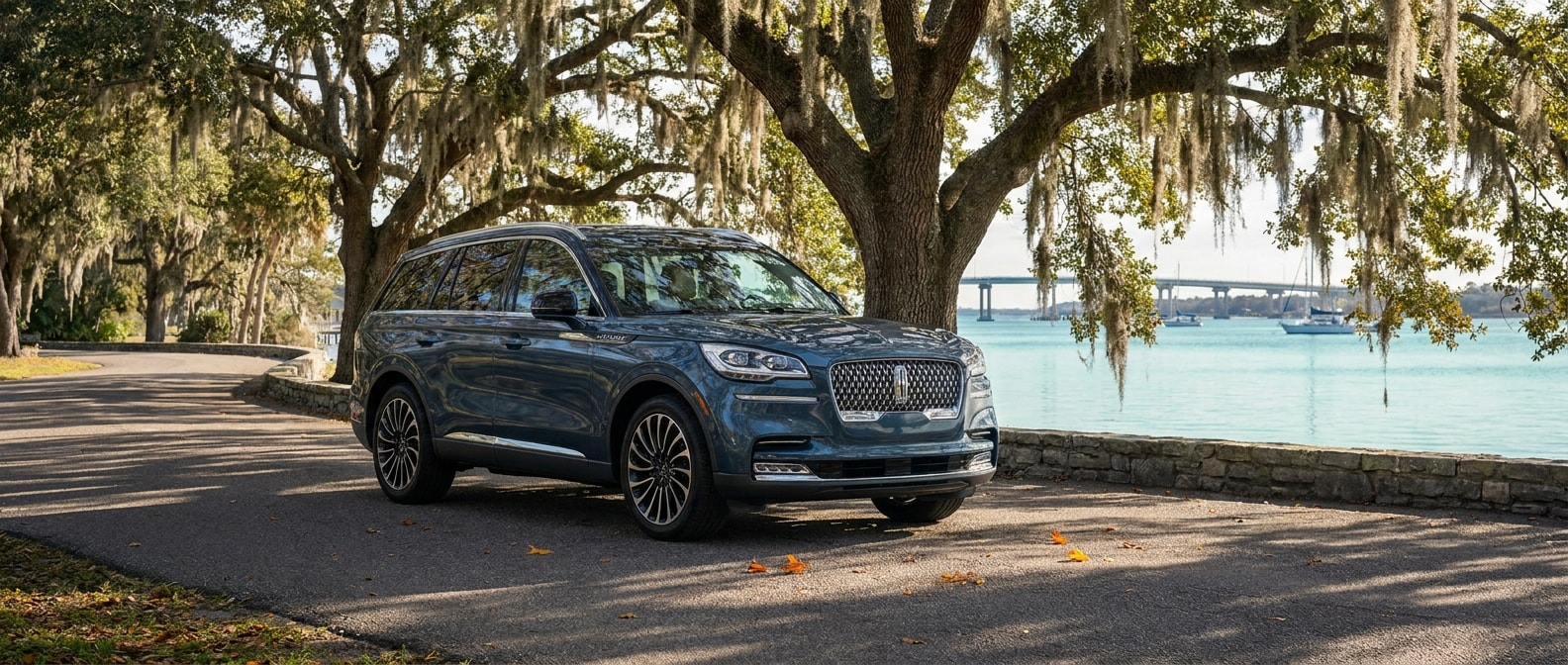
The bottom line is simple. The Premiere is more capable than buyers expect, the Reserve earns its step-up with specific features worth naming, and the Black Label is a considered lifestyle choice rather than a functional upgrade. Drive the Aviator around Panama City and you'll feel it. Thread Beach Drive past Asbell Park, where the road narrows between Lake Caroline and St. Andrews Bay, then pull back out onto US-98 for a longer coastal run. That distinction matters.
Our team spends real time on those routes. The adaptive suspension, standard across all three trims per Lincoln, genuinely changes how the Aviator absorbs the uneven surface patches that show up along that bayfront stretch. You can verify that on the spec sheet.
Browse 2027 Aviator configurations at Bay Lincoln
What Do You Actually Get at Each Tier?
Lincoln builds the 2027 Aviator around a single powertrain, a twin-turbocharged 3.0L V6 producing 400 horsepower and 415 lb-ft of torque paired with a 10-speed automatic, and that engine never changes between trims, so what you pay more for as you climb is everything built around it rather than anything under the hood.
| Trim | What You Actually Get | Who It's For |
|---|---|---|
| Premiere | 400-hp twin-turbo V6, standard adaptive suspension, Lincoln BlueCruise (4 years included), PowerFold third row, 13.2" touchscreen with Google Maps navigation, surround-view camera, heated front seats and steering wheel, Lincoln Co-Pilot360 Drive 2.0 | Buyers who want the full Aviator experience without paying for interior themes they'll never choose |
| Reserve | All Premiere content plus Panoramic Vista Roof, leather seating surfaces, ambient lighting, available Air Glide Suspension (Dynamic Handling Package), available Revel Ultima 3D Audio with 28 speakers, available Illumination Package with adaptive pixel LED headlamps | Families with consistent second-row passengers who value the open roof and the available suspension upgrade for easier vehicle entry |
| Black Label | All Reserve content plus bespoke interior themes with curated color and material combinations, exclusive exterior finishes, and a higher-touch ownership environment by design | Buyers for whom the cabin atmosphere itself is the decision, not additional capability, but a specific kind of experience |
The cargo numbers are the same at every trim. Lincoln lists 16.5 cubic feet behind the third row, 39.9 cubic feet behind the second row with the third folded, and 75.9 cubic feet with both rows flat. That last figure handles a long coastal weekend without negotiation. The PowerFold third row, standard on every 2027 Aviator, folds from the cargo area with a button press. You don't climb over anything to do it.
Getting the Most from the Aviator Near the Waterfront
The surround-view camera earns a specific mention in this section, because East Beach Drive along Asbell Park hands you limited on-street parking, shade trees, a curb on one side and the bay view on the other, and threading into one of those gaps is precisely where a top-down view pays off. If two rows and a smaller footprint fit your commute, the Nautilus is worth comparing
Check the surround-view camera the next time you tuck into a tight bayfront space. Standard at every trim, it gives you a top-down composite of what's immediately around the vehicle when you're maneuvering. Nobody markets it for this scenario. It just happens to be the relevant one.
The parking along East Beach Drive is shaded and limited. The surround-view camera covers both sides at once.
The EPA estimates for the 2027 Aviator with AWD are 17 city / 25 highway / 20 combined MPG (per Lincoln). For a Panama City buyer whose miles run mostly in-town, Beach Drive to Harrison Avenue, the downtown loop, the school pickup, the city figure is the one you live with day to day. Actual results vary with conditions, load, and how hard the climate control is working in October heat (the A/C pulls more than people expect down here). The engine earns that trade, with Lincoln rating the 0-60 time at 5.9 seconds and towing capacity at up to 5,000 pounds when properly equipped. But the city estimate is a real number to carry into the decision.
Pros and Cons Across the Tier Range
The tradeoffs here get clearer once you separate what's standard from what's trim-specific, because the engine, suspension, and camera carry over untouched while fuel economy and third-row space stay the compromises at every tier.
| Pros | Cons |
|---|---|
| 400 hp and 415 lb-ft of torque standard at every trim, the engine is never an upcharge | EPA city estimate of 17 mpg with AWD; short in-town loops will reflect the lower number |
| PowerFold third row standard across all trims, one button from the cargo area | Third-row legroom is 29.2 inches; comfortable for children, genuinely tight for adults on longer runs |
| Lincoln BlueCruise included for four years at every trim | BlueCruise requires a paid subscription after the four-year trial period ends |
| Surround-view camera standard. Unusually useful on narrow bayfront streets | Reserve and Black Label add meaningful cost for features that only matter to specific buyers |
| Adaptive suspension standard. Absorbs the surface variation on Beach Drive and similar routes | AWD is optional on Premiere and Reserve; rear-wheel drive is the base drivetrain configuration |
| Up to 75.9 cu ft of cargo with both rows folded. Genuine weekend hauling capacity | Fuel economy does not improve with the trim step-up; all three trims return the same EPA estimate |
The Choice That Fits This Market
There's no wrong trim here for a buyer who knows what they want, because the powertrain and the core driving hardware carry over untouched, so the decision comes down to roof, materials, and suspension refinement rather than capability. If your priority is maximum interior space and boat-towing capacity, the Navigator is the conversation to have instead
For the Panama City family using the Aviator as a daily driver, the picture looks like this.
- School runs, a waterfront stop at a bayfront park, and the longer pull along US-98 toward the Hathaway Bridge and out to Panama City Beach are all managed without compromise.
- The Premiere is genuinely sufficient on its own, because every feature that defines the Aviator driving experience is standard.
The Reserve makes sense for two specific reasons. First, consistent second-row passengers who value the panoramic roof. Second, buyers who want the Air Glide Suspension (available through the Dynamic Handling Package) for the kneel-on-approach entry behavior. With a car seat installed and a child on one hip, that suspension kneeling is something you notice on every arrival. A kneeling approach with your hands full is a genuine reason to step up. Without one of those two situations, it simply isn't.
The Black Label is a decision about how you want to inhabit the interior. Make it with clear eyes about what you're buying.
One specification is worth holding onto. Per Lincoln, the 2027 Aviator runs on regular unleaded with 87 octane minimum (premium recommended to optimize performance). Over ownership in a market where fuel is a running cost that matters, it's worth knowing before you fill up the first time.
We're at 641 W 15th St in Panama City. Come sit in all three trims. The difference between Premiere and Reserve is the kind of thing you feel in fifteen minutes. Explore financing options at Bay Lincoln
Frequently Asked Questions
Is the Premiere trim a smart choice, or should I step up to the Reserve?
The Premiere is a fully equipped vehicle, not a stripped entry point. Lincoln includes the 400-hp twin-turbo V6, standard adaptive suspension, Lincoln BlueCruise for four years, the surround-view camera system, the PowerFold third row, and Lincoln Co-Pilot360 Drive 2.0 at the base trim. The Reserve's meaningful additions are the Panoramic Vista Roof, leather seating surfaces, ambient lighting, and the available Air Glide Suspension through the Dynamic Handling Package. If those specific features fit how you use the vehicle, the Reserve earns the step. If they don't, the Premiere holds its own without apology.
What is the towing capacity of the 2027 Lincoln Aviator?
Lincoln rates the 2027 Aviator at up to 5,000 pounds of towing capacity when properly equipped, and that figure is consistent across all three trims. Standard towing equipment includes a Class III hitch, four- and seven-pin connectors, a blind-spot system with trailer coverage, and trailer sway control. That capacity handles a fishing boat, a single-axle trailer, or a lighter camper. If your towing needs go beyond 5,000 pounds, the Navigator and Navigator L are the models worth looking at next.