
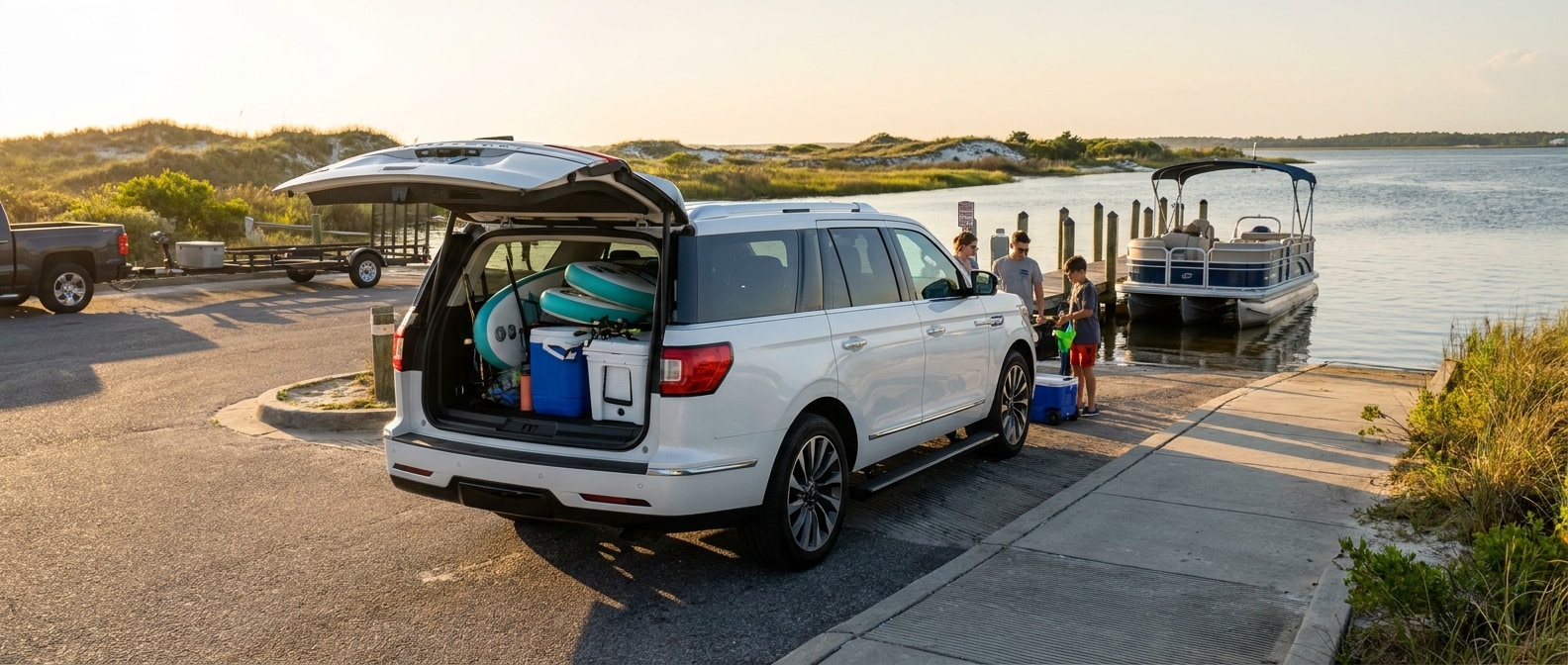
One decision separates a good Navigator L purchase from the right one, and it comes down to whether the L's extra 11 inches of length actually earns its place in your driveway. For Youngstown-area buyers who run the US-231 corridor into Panama City, then turn west toward the coast, there's a quick way to find out. You either fill all three rows regularly, tow something meaningful, or need that rear cargo floor on a real trip. Check even one of those, and the 2026 Navigator L answers questions the standard wheelbase leaves open. Here's the checklist.
What's the Plan at a Glance?
Five stops make up the Navigator L decision journey, and working through them in order means each one either confirms the next or saves you the trouble of going further.
| Checklist Stop | The Decision | The Spec That Settles It | Best Time to Decide |
|---|---|---|---|
| L vs Standard | Do I need the extra rear cargo? | L adds 14.5 cu ft behind row three | Before you visit the lot |
| Towing Package | Am I pulling a boat or trailer regularly? | HD Tow Package raises capacity to 8,700 lbs | With your trailer's GVWR in hand |
| Trim Level | Premiere, Reserve, or Black Label? | Reserve adds Lincoln Rejuvenate, 28-speaker Revel audio, Panoramic Vista Roof | After the test drive |
| Wheel Size | 22-inch or 24-inch? | 24-inch wheels reduce max tow to 8,400 lbs on the L | Before you option-check |
| Financing & Trade | What's my current vehicle worth on the deal? | . | At the end, once the spec is locked |
The L vs Standard: Settle This First
The standard Navigator gives you 21.6 cubic feet behind the third row, and the Navigator L delivers 36.1 cubic feet in that same space. Lincoln gets there by stretching the wheelbase nine inches and the overall length to 221.9 inches. Rear seat legroom doesn't change, which is the elegant part of the engineering.
For a family loading the L at the US-231 ramp before a weekend at St. Andrews State Park's boat basin on Grand Lagoon, that difference shows up right away. Coolers, dry bags, a folded pop-up, and the fishing gear don't require a roof rack. The standard Navigator asks you to choose what stays home. With eight seats and 36.1 cubic feet still accessible, the L doesn't.
The Navigator L runs longer than a full-size pickup at 221.9 inches. Length is the tradeoff. That shows up on tighter Panhandle streets, in older residential garages, and when you're backing a trailer into a narrow boat launch, so if your driving is mostly downtown Panama City and parking already takes a thought, it's a real consideration and not a marketing detail.
Local insight: The boat ramp at St. Andrews State Park on Grand Lagoon has a gravel parking lot with room for 40-plus vehicles and trailer combinations. The L's length reads fine there. Tighter marina ramps in Historic St. Andrews, where you're crossing W 12th Street and reversing a one-way, ask more of the driver.
See Current Navigator L Specials
Towing: The Package Detail Most Buyers Miss
The Navigator L carries a base towing rating of 6,200 pounds without the Heavy-Duty Trailer Tow Package, and Lincoln lists the maximum at 8,700 pounds once the HD Tow Package is installed and 22-inch wheels are specified. Choose 24-inch wheels and that ceiling drops to 8,400 pounds on the L.
The HD Tow Package does more than bump the number. Lincoln includes Pro Trailer Backup Assist, an integrated Trailer Brake Controller, and a dedicated Slow Climb drive mode that manages the powertrain on steep launch ramps. For buyers towing a center-console boat or a loaded fishing trailer down to the Grand Lagoon launch, those features simplify the ritual considerably.
The powertrain stays the same across every trim. A twin-turbocharged 3.5-liter V6 produces 440 horsepower and 510 lb-ft of torque, paired with a 10-speed automatic and standard four-wheel drive. Lincoln rates fuel economy at 15 city / 22 highway / 17 combined for the 4WD configuration. That figure isn't a best-case estimate. It's what EPA certifies for this drivetrain.
The tow package, more than the trim, is the spec that changes the purchase. Know your trailer's GVWR before you sit down.
Trim Level: Where the Checklist Gets Personal
Three trims make up the 2026 lineup, and all of them share the same engine, the 48-inch panoramic display, BlueCruise hands-free driving capability, standard 4WD, and PowerFold third-row seating. From there the choices start to feel personal.
The Premiere opens this generation, and for 2026 Lincoln brought it back to the lineup after its absence in 2025, which matters because it's the first entry point under six figures. Step up to the Reserve and you add the Lincoln Rejuvenate wellness system (the in-cabin relaxation mode that combines massage, curated scents, and ambient display themes), the Revel Ultima 3D audio system with 28 speakers, a Panoramic Vista Roof, and power-deployable running boards. The Black Label layers in exclusive interior themes, Opulence leather across all three rows, and 30-way Perfect Position front seats.
Walking the Premiere and Reserve back to back on our lot, the Revel system is the feature that's hardest to un-hear. The 28-speaker setup and the Rejuvenate mode land differently after a long drive, and that shift is what moves a buyer who came in set on Premiere toward the Reserve. We're not selling a line here. The features do the reframing on their own.
The Lincoln Aviator is worth a mention for buyers genuinely on the fence about whether they need a full-size footprint. It's a different vehicle for a different buyer. Once you've committed to the Navigator L's length because the cargo and tow numbers are real for your life, the trim conversation turns toward features, and the dimensions are already decided.
Next step: If the Reserve trim is where you land, verify that the Panoramic Vista Roof and power running boards are optioned on the specific unit you're considering. These are Reserve features, not universal across the body style. Our team can pull exact build specs on any unit before you make the trip.
The Navigator L on the Panhandle: What the Route Tells You
A drive from Youngstown down US-231 into Panama City, then west on US-98 to Panama City Beach, covers roughly 30 to 35 miles of two-lane, four-lane, and coastal corridor road, and the Navigator L handles all of it without a seam. The 4WD system manages the occasional sandy shoulder at beach access points, and the adaptive suspension (standard across the lineup) absorbs the Hathaway Bridge expansion joints without drama. The cabin stays quiet enough that a conversation in the third row stays a conversation.
On US-98, the thing the route confirms that a spec sheet can't is how unremarkable the L's 221.9-inch length feels in traffic. The vehicle tracks straight, the surround-view cameras take the guesswork out of parking lots, and the power-deployable running boards (Reserve and above) turn third-row entry into something actual humans can use.
What stands out on the highway is the BlueCruise system, which operates hands-free on pre-mapped divided highways; the US-98 stretch through Panama City qualifies. The system monitors eye gaze and head position through a driver-facing camera, and it does disengage when lane markings fade, which happens on some sections of the Panhandle's coastal roads. Think of it as a genuine aid for a long corridor drive, never a hands-off guarantee.
Categories:
Social