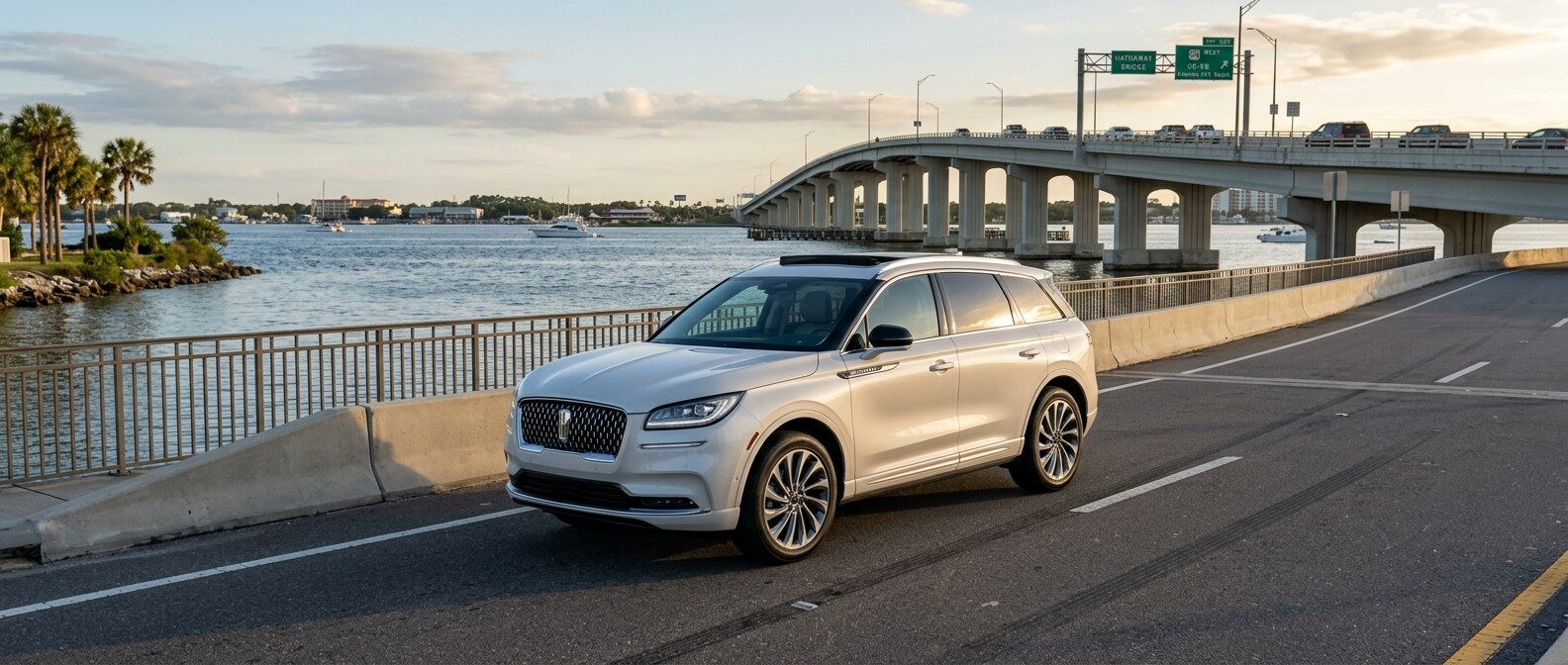
Every version of the 2026 Lincoln Nautilus starts with the same 250-horsepower turbocharged engine, standard all-wheel drive, and that sweeping 48-inch panoramic display. Pick any trim and the Nautilus is still the Nautilus underneath. What shifts is how much of that car you feel once you're moving, and the gap matters most where the roads between Panama City, the Hathaway Bridge, and the coast fill up your mornings.
Three trims. One correct answer for you. Here's how we think through it.
- Premiere: The right pick if BlueCruise 1.5, AWD, and the 48-inch display cover your must-haves and you're not bothered by leatherette seating.
- Reserve: Where the Nautilus becomes a genuinely different daily driver. Adaptive suspension, real perforated leather, 14-speaker Revel audio, and the panoramic Vista Roof arrive as standard, not options.
- Hybrid powertrain (any trim): If US-98 is your commuter corridor, the EPA-estimated 30 mpg combined on the hybrid repays itself steadily on a long coastal drive. Lincoln rates the standard gas engine at 24 mpg combined.
- Black Label: The experience tier, not the spec tier. The gap over Reserve buys personalization, a 28-speaker audio system, and curated interior themes. Worth it if those things matter to you.
- Our honest take: For most Millville and Panama City drivers we talk to, Reserve is the stopping point. The adaptive suspension alone changes the ride character on road surfaces that vary a lot between the bridge approach and a downtown block.
What Actually Matters When Choosing a Nautilus Trim?
Most of what separates one Nautilus trim from another on a spec sheet barely registers once you're behind the wheel, so the two things worth weighing before you buy are the suspension calibration and the powertrain you choose, and everything else falls behind them. Spend a few minutes comparing columns and you'll see dozens of features. Only a couple change the drive. The rest is background you can set aside.
| Trim | Best For | Key Spec | Tradeoff |
|---|---|---|---|
| Premiere | First-time luxury buyer, tech-forward daily use | 250 hp turbo, BlueCruise 1.5 standard, 48-inch display | Leatherette (not genuine leather); no adaptive suspension; 10-speaker audio |
| Reserve | Long Panhandle highway runs, comfort-first buyer | Adaptive suspension (CCD), genuine perforated leather, 14-speaker Revel, panoramic Vista Roof | Slightly less cargo volume (35.2 vs 36.4 cu ft) versus Premiere due to the Vista Roof structure |
| Reserve + Hybrid | Coastal commuters who cross the bridge daily | EPA-estimated 29 city / 31 hwy / 30 mpg combined; 285 hp combined output | CVT transmission instead of the 8-speed automatic; some drivers notice the different response |
| Black Label | Buyers who want the full personalization experience | 22-inch wheels, 28-speaker Revel Ultima 3D, exclusive interior themes | Largest curb weight (4,517 lbs vs Reserve's 4,349 lbs); premium is mostly experiential, not spec-driven |
The table lays out what each trim delivers on paper. The harder question is which of those specs actually surface when you're driving, long after the brochure's back on the rack.
The Adaptive Suspension Is the Reserve's Real Argument
Lincoln fits the 2026 Nautilus with two different suspension setups, and that single choice does more to shape the daily feel than any badge or wheel size, with the Premiere running conventional hydraulic shocks while the Reserve and Black Label step up to Continuous Control Damping (CCD). CCD adjusts damping in real time off the road inputs underneath you. That's the spec. And here's what it means.
Our team has run both configurations on the road, and the difference is something you feel in your hands, not a line item on a comparison. Panama City throws a real mix at any suspension. Smooth stretches on US-98, the deliberate expansion joints crossing the Hathaway Bridge, then rougher pavement through the older downtown blocks. CCD soaks up that variation without fuss, and the Premiere isn't harsh by any stretch, though you'll feel those transitions more than you would in the Reserve.
The Lincoln Aviator uses a comparable adaptive setup in its class, and the feedback we hear across both vehicles lines up. Once you've spent time with continuous damping control on varied surfaces, standard shocks feel like a step backward. It is a genuine tradeoff worth knowing before you buy.
Pros and Cons at a Glance
| Pros | Cons |
|---|---|
| BlueCruise 1.5 is standard on all three trims, with a four-year subscription included | Premiere uses leatherette, not genuine leather. It holds up fine but feels different |
| AWD is standard across the entire 2026 Nautilus lineup | Adaptive suspension is Reserve and Black Label only; Premiere misses it |
| 48-inch panoramic display arrives even on the entry Premiere | The hybrid CVT transmission feels distinct from the gas 8-speed; not worse, just different |
| Reserve's 14-speaker Revel audio is a substantial step up from the Premiere's 10-speaker system | Black Label's premium over Reserve buys more personalization than new mechanical capability |
| EPA-estimated 30 mpg combined on the hybrid makes long coastal runs noticeably more efficient | The Reserve III Package with massaging seats is an added option, not standard on base Reserve |
Match the Trim to How You Actually Drive
Matching a Nautilus trim to your routine really comes down to one question, which is how much of your week genuinely happens on the highway, with the Premiere covering everyday in-town driving comfortably and the Reserve earning its keep the moment long coastal runs become your normal. We walk customers through a simple frame at our lot.
- A run to the grocery store on 23rd Street, a commute that stays inside Panama City, and maybe a monthly trip up US-231 toward Marianna for the weekend. The Premiere covers that comfortably.
- BlueCruise 1.5 is there when you want it. The display is the same 48-inch unit.
- You won't feel cheated on shorter drives where the highway doesn't dominate your week.
If your drive runs longer, or the highway is where you spend serious time (running the coastal corridor toward 30A and the beach communities, handling airport pickups at ECP, or logging enough US-98 miles that a quiet, settled highway feel becomes part of your day), the Reserve is your trim. The adaptive suspension pays back in exactly those conditions. Its Revel audio is a step up you can hear, not a line on the window sticker.
The hybrid question stands on its own. If you're logging real highway miles, Lincoln rates the hybrid at 29 city / 31 highway / 30 combined mpg, against 21 city / 29 highway / 24 combined for the gas engine. Across a coastal driving pattern, that gap keeps adding up. The CVT is the cost of that efficiency.
Black Label suits a particular kind of buyer, someone who cares about a curated interior theme, the 28-speaker Revel Ultima 3D audio, and the concierge-level ownership experience. If those things speak to you, the premium is worth it. If they don't, the Reserve is the more sensible stopping point.
No trim here is a wrong choice. The Nautilus sets a high floor, and we're just here to help you find the ceiling that fits your drive.
Frequently Asked Questions
Does every 2026 Lincoln Nautilus trim include BlueCruise?
Yes. Lincoln includes BlueCruise 1.5 as standard on all three 2026 Nautilus trim levels, including the Premiere. The system enables hands-free driving on designated highway segments and now includes automatic lane-change capability. A four-year subscription is included with the vehicle. You don't need to move up to Reserve or Black Label to access it.
Is the Lincoln Nautilus hybrid worth it for Panama City driving?
It depends on the miles. Lincoln rates the 2026 Nautilus hybrid at an EPA-estimated 30 mpg combined versus 24 mpg combined for the standard gas engine. On a coastal driving pattern that includes regular highway miles on US-98 or runs out to ECP, the efficiency gap is real and steady. The hybrid also bumps combined system output to 285 horsepower. The tradeoff is the CVT transmission, which some drivers prefer and some find takes getting used to. We'd encourage you to drive both back to back before deciding.