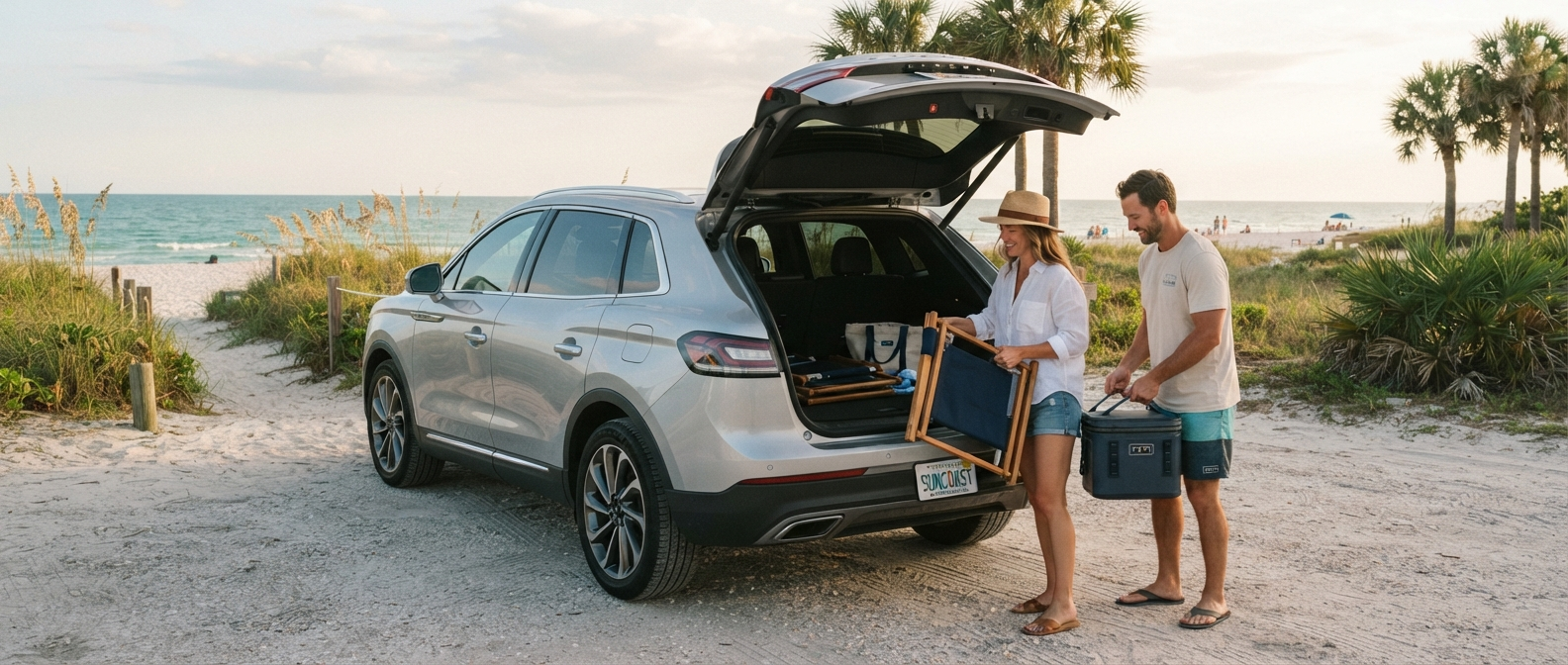
The US-98 corridor from Panama City to Santa Rosa Beach is about 41 miles of straight coastal road. You know the one. On a weekend afternoon it gets crowded, and the last thing you want is to pull in and find the cooler wedged against a seat you should've folded back in the driveway.
The 2026 Lincoln Nautilus gives you real flexibility here. Two rows, five seats, a 60/40 split-folding rear bench, and a cargo floor that drops nearly flat. But the setup that works for two adults and a dog isn't the setup for a family of four with a full beach kit. Below is how to read the cabin, configure it for what you're actually hauling, and sort out the one spec difference between trims that trips up plenty of buyers.
Browse our 2026 Lincoln Nautilus inventory at Bay Lincoln to see current trim availability.
What You Need to Know Before You Load
A quick specs table saves you the guesswork at the tailgate, and it's worth a look before you settle on a trim, because the Nautilus splits its cargo numbers by trim and that gap is small but real enough to matter when you're stacking a cooler against a folded seat.
| Spec | Premiere | Reserve / Black Label |
|---|---|---|
| Cargo behind second row | 36.4 cu ft | 35.2 cu ft |
| Max cargo (seats folded) | 71.3 cu ft | 68.8 cu ft |
| Rear headroom | 39.8 in | 38.4 in |
| Front legroom | 43.5 in | 43.5 in |
| Rear legroom | 43.1 in | 43.1 in |
| Seating capacity | 5 | 5 |
| Liftgate | Power (standard) | Power (standard); hands-free available |
Lincoln publishes those figures separately by trim, and the difference isn't arbitrary. The Reserve and Black Label trims carry a Panoramic Vista Roof, thicker premium interior panels, and elevated seating surfaces. Those additions trade roughly 1.2 cubic feet of behind-seat space and about 1.4 inches of rear headroom for a cabin that feels noticeably more finished. Whether that tradeoff works for you depends on what you load and who's riding in back.
One thing surprises people here. The hybrid powertrain doesn't cost you any cargo space, because Lincoln tucks the hybrid battery under the rear load floor and keeps cargo volume identical to the gas model. So if you're cross-shopping hybrid against standard for fuel economy, look elsewhere. Cargo isn't the deciding factor.
Setting Up the Cabin: Step-by-Step
The 2026 Nautilus uses a 60/40 split-folding rear seat, and that split is the key to mixed loads, since it lets you fold one section down for gear while a passenger keeps riding comfortably on the other side of the bench. Below is how we think about the configurations, in the order our team actually walks buyers through at pickup.
Step 1: Decide who is riding and who is not. If you're carrying four adults to Santa Rosa Beach, everyone sits and cargo is whatever fits in the 36.4 cubic feet behind the row. That's enough for a 48-quart cooler, a couple of folding chairs, and a bag or two without stacking anything. Comfortable, no compromises.
Step 2: Identify your split. For three adults plus gear, fold the 40 percent section on the driver's side. You add roughly 14 cubic feet of usable floor behind that section without disturbing the passenger side. The seat folds forward and flat, with no levers to hunt for. The seatback drops and lands nearly level with the cargo floor.
Step 3: For a two-person day trip with serious gear, fold both sections. At 71.3 cubic feet (Premiere) or 68.8 cubic feet (Reserve/Black Label), you've got a flat floor running from the back of the front seats to the liftgate. It fits a large cooler, two beach chairs, a tent or beach canopy, paddle boards stood upright lengthwise, and still leaves room for a bag at each side. The floor is wide enough that a standard 70-quart cooler sits flat with room to close the liftgate comfortably.
Step 4: Use the under-floor storage for what should stay hidden. There's a storage compartment beneath the cargo floor. Browse available configurations to see which trims include a cargo organizer. Near the Gulf, salt air and blown sand get into everything, so our team tells buyers that hidden space is where the first-aid kit, the jumper pack, and the car charger belong, not a bag sliding around behind a seat.
Step 5: Use the power liftgate correctly in a tight space. If you're parked at one of the 30A beach accesses with cars close behind you, the full-open sweep of the liftgate is something to plan for. Premiere has a standard power liftgate with a programmable height stop. Reserve and Black Label add the hands-free version, which opens with a foot motion under the bumper. Set the height stop before the first trip. The default position is built for an open parking lot, not a compact beach access with a truck two feet behind you.
Step 6: Set the rear seatback angle before long hauls. The 2026 Nautilus second row doesn't just fold flat. It also slides fore and aft for legroom. If your back-row passengers want maximum legroom on the US-98 run west, slide the seat to its rearmost position. If you're prioritizing cargo depth over legroom (paddleboards that need every inch of length, say), slide the row forward before folding.
The Trim Tradeoff, Honestly
We'll say it plainly, because it shapes how you load this vehicle, and the short version is that the Reserve and Black Label trims give up a little cargo volume next to the Premiere, with Lincoln listing 35.2 cubic feet behind the second row against 36.4 on Premiere. That 1.2-cubic-foot difference isn't going to leave your cooler in the driveway. It's a real number that reflects real interior upgrades. The panoramic roof adds glass and structural mass overhead, and the elevated interior finishes take a measured bite from total volume.
The headroom difference is more noticeable. Reserve and Black Label measure 38.4 inches of rear headroom versus 39.8 on Premiere. For riders under about 5 foot 10, neither feels limiting. Taller back-row passengers may notice it, especially on a long run, so that's worth knowing before you assume a pricier trim wins in every direction. For a second-home owner driving to 30A a few times a month with a regular crew, the Reserve's massaging seats and panoramic roof can be worth more than 1.2 cubic feet. For someone who loads heavy and hauls often, Premiere gives back some of that space without giving up the quiet-cabin experience the Nautilus is built around.
If you need a third row alongside Nautilus-level refinement, the Lincoln Aviator is the natural step. But if two rows and a flat cargo floor is the right answer, the Nautilus does it well.
Print-and-Go Recap for Your Next Santa Rosa Beach Trip
- [ ] Decide seating before you load: 4+ passengers means all seats up
- [ ] Fold the 40% section for a mixed crew (3 adults plus gear)
- [ ] Fold both sections for a full flat floor: 71.3 or 68.8 cubic feet depending on trim
- [ ] Slide the second row forward before folding to maximize cargo length
- [ ] Load the under-floor compartment with items that should stay out of sight
- [ ] Set liftgate height stop in Vehicle Settings before any tight-space parking
- [ ] Confirm hands-free liftgate is enabled if you have a Reserve or Black Label
One last thing worth saying out loud. The Nautilus is genuinely quiet at highway speed on US-98. Lincoln's active noise cancellation works, and the second row is where you feel it most. A family of four running from Panama City through Panama City Beach and out along the 30A corridor is going to hear the Gulf breeze and not much else. That design priority shows up in every spec we've listed above, including the ones about roof glass and interior materials.
When you're ready to talk numbers, reach out to our team at Bay Lincoln.
Frequently Asked Questions
Does the 2026 Lincoln Nautilus hybrid version lose cargo space compared to the standard gas model?
No. Lincoln packages the hybrid battery under the rear load floor, which keeps cargo volume identical across powertrains. Premiere hybrid delivers 36.4 cubic feet behind the second row and 71.3 cubic feet with the seats folded, the same as the gas-powered Premiere. Reserve and Black Label hybrid versions match their gas equivalents at 35.2 and 68.8 cubic feet respectively.
Why does the Reserve trim have less cargo space than the Premiere?
The Reserve and Black Label trims include a Panoramic Vista Roof and thicker premium interior panels that take a measured amount of space from total cargo volume and reduce rear headroom from 39.8 inches (Premiere) to 38.4 inches. The difference in cargo volume is 1.2 cubic feet behind the second row. It is a direct consequence of the interior upgrades, not a design oversight.