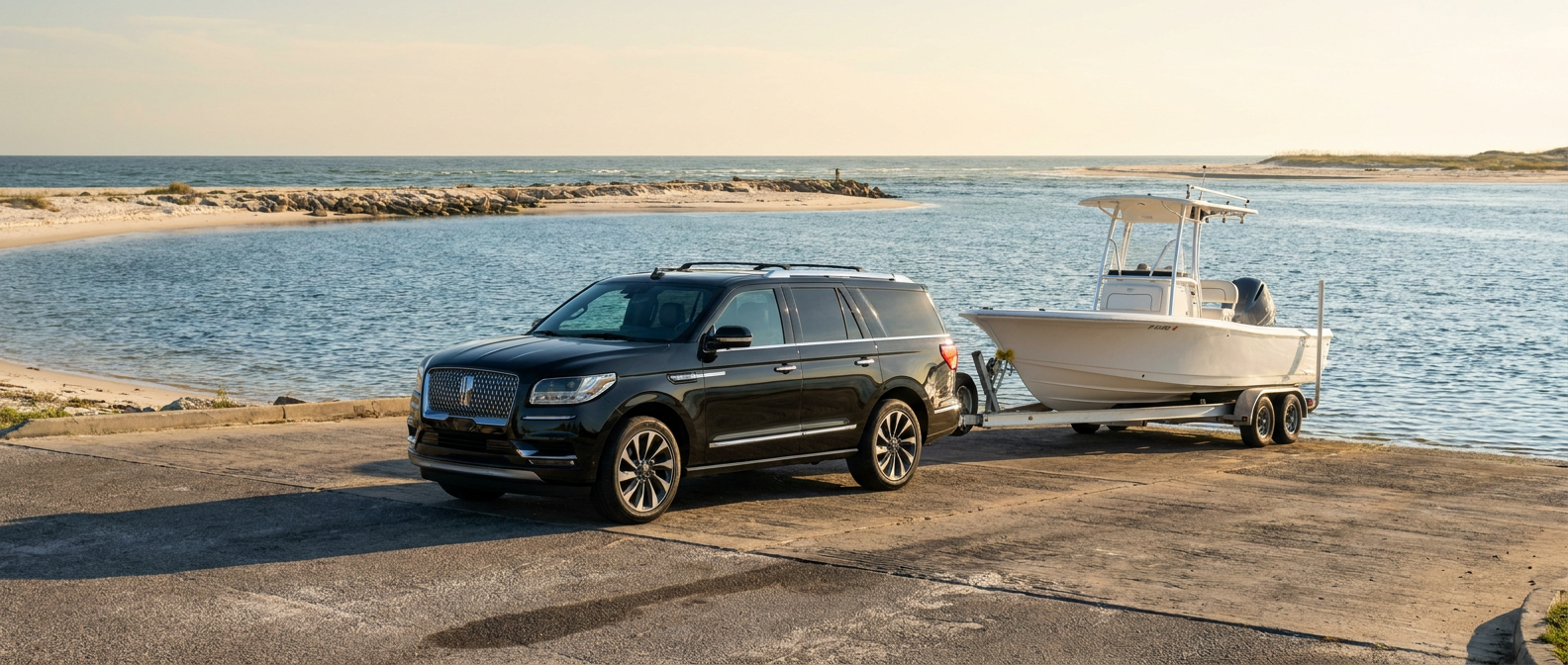
The run from Millville out to Grand Lagoon on US-98 is short. Picking which 2026 Lincoln Navigator configuration to bring is not.
Pull a boat to the St. Andrews State Park ramp, load coolers, waders, or kayak gear for a day on the lagoon, or drive a full cabin of adults south from Panama City, and the Navigator lineup hands you two body lengths plus an optional tow package that meaningfully change what you can do. Choose wrong and you're folding a seat to fit gear that should have fit. Choose right and everyone sits, everything loads, and you arrive unhurried.
Get that choice sorted before you show up at the ramp, and the rest of the day takes care of itself.
- Pulling a boat up to 8,700 lbs: you need the available Heavy-Duty Trailer Tow Package on either body length (the standard trailer receiver alone is rated lower)
- Carrying a full cabin of seven or eight AND gear behind row three: the Navigator L's 37.4 cu ft behind the third row (vs 22.9 in the standard) solves the compromise
- Day trip with four to five people and soft coolers: the standard Navigator's 22.9 cu ft behind row three handles it without the longer footprint at the ramp
- Third-row legroom is the same in both. 36.5 inches, so the L doesn't buy you more passenger comfort, only more cargo depth
- Salt air near Grand Lagoon affects paint and trim over time; the interior-focused Reserve and Black Label packages both add the features worth protecting
What actually matters when choosing between the Navigator and Navigator L?
The passenger experience is identical across both body lengths, so this decision is about cargo depth, comfort being equal whichever you choose, and the L earns its keep when every seat stays occupied and gear still needs room behind them. Lincoln builds both with the same 172.1 cubic feet of passenger volume and the same third-row legroom, so the L won't help if you're hoping for more room back there. The L helps when you need cargo while every seat is full.
The cargo numbers are where they split.
| Configuration | Cargo Behind Row 3 | Cargo Behind Row 2 | Max Cargo (All Rows Down) | Overall Length |
|---|---|---|---|---|
| Navigator (standard) | 22.9 cu ft | 60.8 cu ft | 107.0 cu ft | 210 inches |
| Navigator L | 37.4 cu ft | 75.4 cu ft | 121.6 cu ft | 221.9 inches |
| Advantage | L adds 14.5 cu ft with seats up | L adds 14.6 cu ft | L adds 14.6 cu ft | L adds 11.9 in |
| Scenario | Best Fit | Key Spec | Honest Tradeoff |
|---|---|---|---|
| Towing a center-console to St. Andrews ramp | Either, with HD Tow Package | Up to 8,700 lbs tow rating (properly equipped) | 24-inch wheel option drops rating to 8,400 lbs |
| Full cabin (7-8 people) plus fishing gear | Navigator L | 37.4 cu ft behind row 3 | 221.9 inches long is tight in narrow ramp lots |
| Day trip, 4-5 passengers, soft bags | Navigator (standard) | 22.9 cu ft behind row 3 | Fold a seat if you overpack |
| Boat-free weekend with lots of beach gear | Navigator (standard) | 107 cu ft max with seats down | Gives up that rear cargo depth vs the L |
| Week-long family trip needing all rows up | Navigator L | 121.6 cu ft max | Longer wheelbase, plan parking accordingly |
The footprint is the tradeoff on the L. Twenty-one feet and almost ten inches rides composed on US-98. At a congested weekend ramp, that extra foot at the stern matters when you're backing a trailer.
Towing capacity is the variable that changes based on how you configure either model
Both body lengths of the 2026 Navigator run the same twin-turbocharged 3.5-liter V6, producing 440 horsepower and 510 lb-ft of torque through a 10-speed automatic and standard four-wheel drive, so the hardware never limits you, and what changes the tow number is the package you spec, not the length you pick. Lincoln lists the maximum tow rating at 8,700 pounds when properly equipped. That "properly equipped" phrase does real work here.
The available Heavy-Duty Trailer Tow Package is what unlocks that 8,700-lb ceiling. It adds a Class IV receiver with four-pin and seven-pin connectors, a smart trailer tow system, a trailer brake controller, trailer sway control, a two-speed transfer case, and an upgraded radiator. Without it, you're working with the base towing setup, built for lighter loads.
Browse our current Navigator inventory to see which trims include the package or offer it.
Our team watches one detail on the spec sheet. Opt for the available 24-inch wheels and Lincoln's published figures drop the tow rating to 8,400 to 8,500 pounds. For most boats running into Grand Lagoon, that's still plenty. If you're near the ceiling with a larger vessel, though, the wheel choice matters.
The EPA rates the 2026 Navigator at 15 city / 22 highway / 17 combined mpg with the standard 4WD system. That figure holds across both the standard and L body lengths. The L does carry a larger fuel tank (27.8 gallons on the Navigator L vs 23.6 on the standard), which stretches the range between fill-ups on longer runs toward Lynn Haven or out along the coast.
- The heavy-duty tow package is available at the Premiere trim level and above
- BlueCruise hands-free highway driving comes standard on all 2026 Navigator trims
- The 48-inch panoramic display is standard across the lineup, not a reserved-trim exclusive
- Ground clearance is 8.9 inches on both body lengths. Enough for uneven ramp surfaces
- Salt-air exposure near Grand Lagoon makes interior-material quality worth considering at trim selection; Reserve adds ventilated second-row seats and upgraded captain's chairs
Match the configuration to how you actually use this corridor
Match the body length to what rides behind your passengers, not to the drive itself, because the Millville-to-Grand-Lagoon run is short and the test comes at the ramp, where a wrong pick costs you maneuvering room on a busy morning. The standard length suits most weekend boat runs. The L earns its extra foot only when every seat stays full and the gear still has to fit.
The St. Andrews State Park ramp on Lower Grand Lagoon is a double-sided concrete launch with a small per-vehicle entry fee, a relaxed setup that handles everything from kayaks to larger offshore vessels. What it doesn't have is unlimited maneuvering room on a busy Saturday morning.
The Navigator L earns its length on extended family trips where every seat stays occupied and gear still has to fit behind row three without folding anything. Run six adults from Millville down to the lagoon for a full-day charter and the 37.4 cubic feet behind that third row is the difference between traveling intact and asking someone to hold the cooler.
The standard Navigator is the cleaner pick for the household that pulls a boat most weekends with two or three people aboard:
- Twenty-two-point-nine cubic feet behind row three is room enough for dry bags, tackle, and a small cooler
- The shorter footprint (210 inches) is easier to manage when you're lining up a trailer on a ramp
On a packed Saturday ramp, the L's a pain to back. No way around it. The longer body buys cargo depth and gives back maneuverability, and for a typical weekend boat run that trade doesn't always favor it.
Neither vehicle's wrong for this corridor. The choice narrows to what you're carrying behind your passengers.
See Current Navigator Specials
Ready to walk through the configurations side by side?
Frequently Asked Questions
Can the 2026 Lincoln Navigator tow a boat to the Grand Lagoon ramp at St. Andrews State Park?
Yes. With the available Heavy-Duty Trailer Tow Package, the 2026 Navigator reaches a published maximum of 8,700 pounds of towing capacity when properly equipped and configured. That covers the range of center-console and bay boats common to the Grand Lagoon area. The St. Andrews State Park boat ramp is a double-sided concrete launch on Lower Grand Lagoon, open daily from 8 AM to sundown and accessible from Millville via US-98. Verify that your specific trailer GVWR and tongue weight fall within your Navigator's rated limits before loading up.
Does the Navigator L have more passenger room than the standard Navigator?
No. Lincoln publishes the same 172.1 cubic feet of passenger volume and the same third-row legroom for both body lengths. The 11.9 additional inches of the L go entirely into cargo depth behind the third row. From 22.9 cubic feet in the standard to 37.4 cubic feet in the L. If your main goal is extra legroom for rear passengers, both models deliver the same space. If your goal is cargo behind a full cabin of seven or eight people, that's where the L makes its case.