
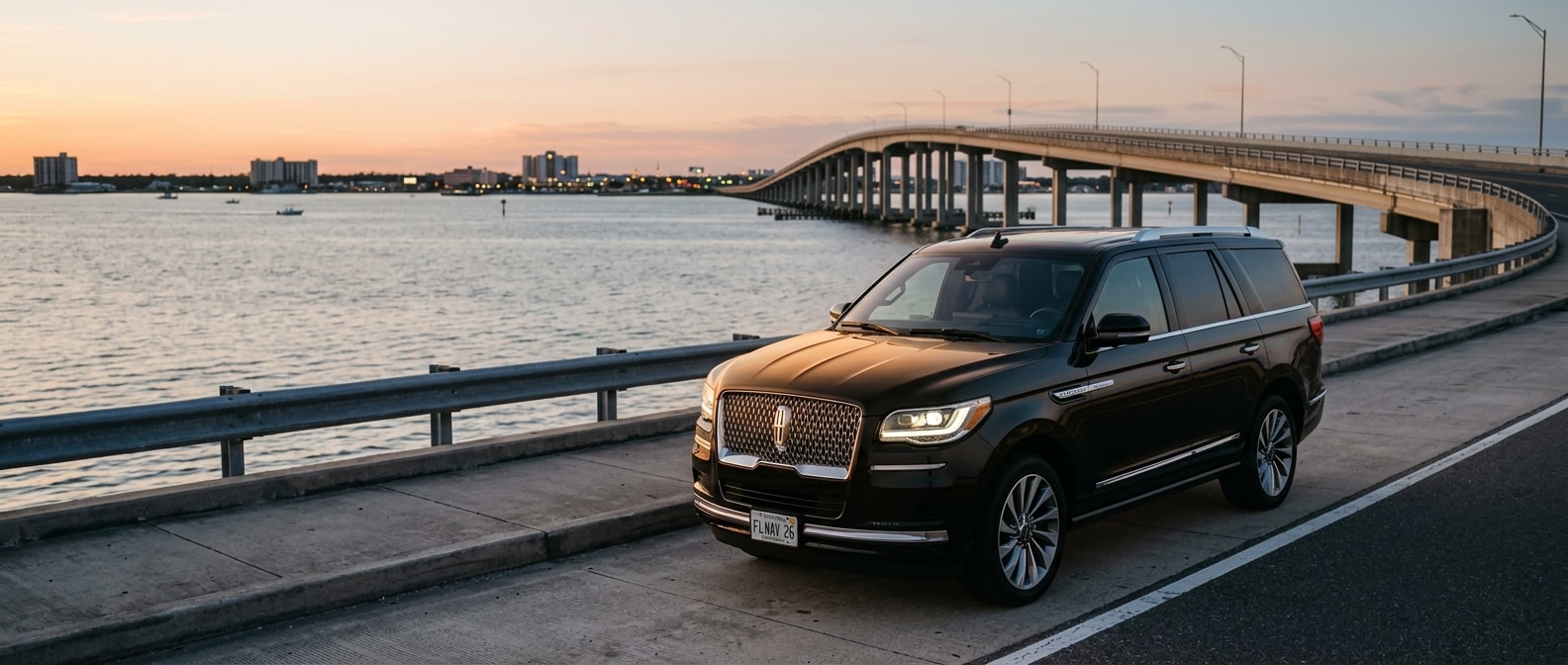
A Navigator visit without prep wastes everyone's time, yours and ours. The spec sheet is easy to find. What's harder is knowing which questions truly separate the right configuration from a regretful one, and those questions shift depending on how you live here on the Panhandle. We built this list around Bay County specifically, longer drives on US-98, coastal salt air, boat launches off St. Andrew Bay, airport pickups at ECP, and the kind of packing that comes with a week on the water rather than a weekend in the suburbs.
Browse the 2026 Navigator on our lot and come back to the list, or print this page and bring it with you.
What Goes on the Checklist?
Work through these eight questions before you sit in the driver's seat, because each one carries a yes or no answer that narrows your configuration down to the one Navigator that fits your life here, and sorting them on the couch beats sorting them under showroom lights.
1. Standard or Navigator L? The standard wheelbase is 122.5 inches, 210 inches overall. The Navigator L stretches to 131.5 inches wheelbase, 221.9 inches overall, nearly a foot longer bumper to bumper. Lincoln lists 21.6 cubic feet of cargo behind the third row in the standard body and 36.1 cubic feet in the L. The gap isn't small. It decides whether beach chairs and coolers ride behind seven people or whether something stays on the driveway. Check your garage depth before you come in.
2. Do you tow? The factory base rating is 6,200 pounds. With the available Heavy-Duty Trailer Tow Package and 22-inch wheels, Lincoln rates the 2026 Navigator at 8,700 pounds. That package also adds a trailer brake controller, a two-speed transfer case, and Slow Climb drive mode. If you're pulling a center-console or a pontoon, you'll want to know whether the vehicle on our lot already has it or needs to be ordered that way.
3. Seven or eight passengers? Standard configuration gives you second-row captain's chairs with a center pass-through aisle, seating seven. The available 40/20/40 PowerFold bench replaces those and seats eight. The pass-through is the practical detail. With captain's chairs, a child or teenager walks straight to row three without anyone folding forward; with the bench, you gain the extra seat and lose that walkway. Figure out which one your third-row passengers actually are before you decide.
4. Which trim is your real entry point? The 2026 lineup runs Premiere, Reserve, and Black Label, all with 4WD standard. The Premiere reappeared for 2026 and comes genuinely well-equipped, with a 48-inch panoramic display, standard BlueCruise hands-free highway driving, four years included, climate-controlled front seats, and the Revel audio system. Reserve adds second-row captain's chairs with heat and ventilation plus the full 28-speaker Revel Ultima 3D audio. Black Label moves the front seat to 30-way Perfect Position adjustment and adds the Rejuvenate wellness suite. Know which features you'll use, and let that pick the badge.
5. Have you confirmed the drive modes? The Navigator runs five standard drive modes: Normal, Excite, Conserve, Slippery, and Deep Conditions. The Heavy-Duty Trailer Tow Package adds Slow Climb. "Deep Conditions" and "Slow Climb" read like brochure language until you're on a wet boat ramp or a soft shell road up toward Marianna. It's worth understanding what each one does for you during your test drive.
6. BlueCruise: do you know how it works here? BlueCruise handles hands-free highway driving on pre-mapped divided highways. A driver-facing camera monitors eye gaze and head position while the system is active. It stays a driver aid under your judgment, and nothing about it drives the car for you. On a long US-98 run toward Panama City Beach or up US-231 toward I-10, it does exactly what it's designed to do. Ask our team to walk you through activation before you leave the lot.
7. Fuel range planning The EPA rates the 2026 Navigator's twin-turbocharged 3.5-liter V6 at 15 city and 22 highway miles per gallon (4WD). The standard tank holds 23.6 gallons; the Navigator L carries 27.8 gallons. On a longer Panhandle run that spread matters. Actual mileage varies with climate-control use, load, and driving conditions.
8. Salt-air corrosion: ask about the undercarriage You're buying this vehicle in a coastal environment. Salt air and humidity are a real maintenance consideration for any vehicle kept near St. Andrew Bay or along the coast. Ask our service team specifically about protective coatings and what the maintenance schedule recommends for undercarriage care in this climate.
Why Each Item on the Checklist Actually Matters
The towing question deserves far more than a yes or no, because the 2,500-pound gap between the base rating and the equipped rating decides whether the Navigator can pull what Bay County boaters tow off St. Andrew Bay. A twin-engine bay boat or a well-loaded travel trailer can top 6,200 pounds without much effort. If the vehicle leaves our lot without the Heavy-Duty Trailer Tow Package, adding it later isn't straightforward. You order it from the factory or you don't get it. Decide before you buy.
See Navigator L configurations available now, the body choice is the one decision that can't be made at delivery.
The Navigator vs Navigator L question has a clean answer for most Bay County buyers. If you routinely carry six or seven passengers and significant cargo, the L's 36.1 cubic feet behind row three (versus 21.6 in the standard) closes the argument. If you're mostly a five-passenger household with occasional third-row use, the standard body's 210-inch overall length is more practical in tighter parking and easier on most residential garages. Neither is the wrong answer. They just answer different questions.
A note from our team: Seating configuration is the decision worth slowing down on, and it rides on a detail that's easy to leave at home. If a car seat goes in row two regularly, the captain's chair layout simplifies daily life, since you're not folding or shuffling to get a child in and out of row three. If your third row carries adults or older teenagers, the bench and its eighth seat may serve you better. Think through your actual weekly load before you sit down.
The BlueCruise question matters here because US-98 and US-231 are exactly the kind of divided-highway corridors the system is mapped for. BlueCruise is standard on the 2026 Navigator across all trims, and the four-year subscription is included. None of that excuses skipping the walkthrough. The driver-facing camera monitoring is part of how the system works, and some drivers find it unfamiliar at first. Ask for a demonstration run before you take delivery.
| Checklist Item | Why It Matters Here |
|---|---|
| Standard vs Navigator L | Garage depth and cargo-behind-row-3 (21.6 vs 36.1 cu ft) |
| HD Tow Package | Jumps max tow rating from 6,200 to 8,700 lbs. Factory config only |
| 7- vs 8-passenger config | Captain's chair pass-through vs bench for row-three access |
| Trim level (Premiere/Reserve/Black Label) | Audio, seat adjustment, and wellness features are tier-specific |
| Drive modes | Slippery and Deep Conditions matter on wet ramps and shell roads |
| BlueCruise familiarity | Hands-free highway aid. Understand the driver-camera requirement first |
| Fuel range | Navigator L's 27.8-gallon tank extends range on longer Panhandle runs |
| Undercarriage care | Coastal salt air is a real maintenance factor; ask the service team |
Explore financing options while you have the configuration narrowed down.
Get a Trade-In Estimate Before Your Visit
Your Print-and-Go Recap
Bring these eight answers to your appointment and we can usually handle the configuration conversation in a single sitting rather than stretching it across two visits, since the hard thinking will already be done and all that remains is matching your answers to what sits on the lot.
- [ ] Measured my garage depth (standard: 210 in / Navigator L: 221.9 in total length)
- [ ] Confirmed towing need (base 6,200 lbs; with HD Tow Package: 8,700 lbs)
- [ ] Decided 7- or 8-passenger (captain's chairs vs bench. Think through the car-seat question)
- [ ] Identified which trim features I'll actually use (48-inch display and BlueCruise are standard on Premiere)
- [ ] Ready to ask about drive mode demo on the test drive
- [ ] Understand BlueCruise is a hands-free highway aid, not autonomous driving
- [ ] Noted the fuel tank difference (23.6 gal standard / 27.8 gal Navigator L) for my typical routes
- [ ] Asked the service team about undercarriage maintenance in a coastal environment
See current Navigator inventory at Bay Lincoln and check which configurations are on the lot today.
The 2026 Navigator is a considered purchase, one of those vehicles that rewards preparation. Come in knowing these eight answers and you'll walk out with a configuration that fits your actual life on the Panhandle rather than a spec sheet that looked right on a screen. Walk in ready.
Frequently Asked Questions
Does the 2026 Lincoln Navigator come with a towing package?
The 2026 Navigator carries a base towing capacity of 6,200 pounds without a trailer tow package. With the available Heavy-Duty Trailer Tow Package and 22-inch wheels, Lincoln rates it at 8,700 pounds. That package adds a trailer brake controller, a two-speed transfer case, and Slow Climb drive mode. You order it as a factory configuration, not as an add-on at delivery. If towing a boat or trailer is part of your plan, confirm whether the vehicle on the lot already includes it or whether you need to specify it on an order.
What is the real difference between the Navigator and Navigator L for a Bay County family?
The Navigator L adds 11.9 inches of overall length and expands cargo space behind the third row from 21.6 cubic feet (standard) to 36.1 cubic feet. Maximum total cargo grows from 107 to 121.6 cubic feet. The trade-off is genuine. The L's 221.9-inch overall length wants a deeper garage and feels less maneuverable in tighter lots. For a household that regularly carries six or seven passengers alongside gear for a beach week, the L resolves the cargo math. For a five-passenger household using row three occasionally, the standard body covers the need with fewer parking headaches.
Categories:
Social