
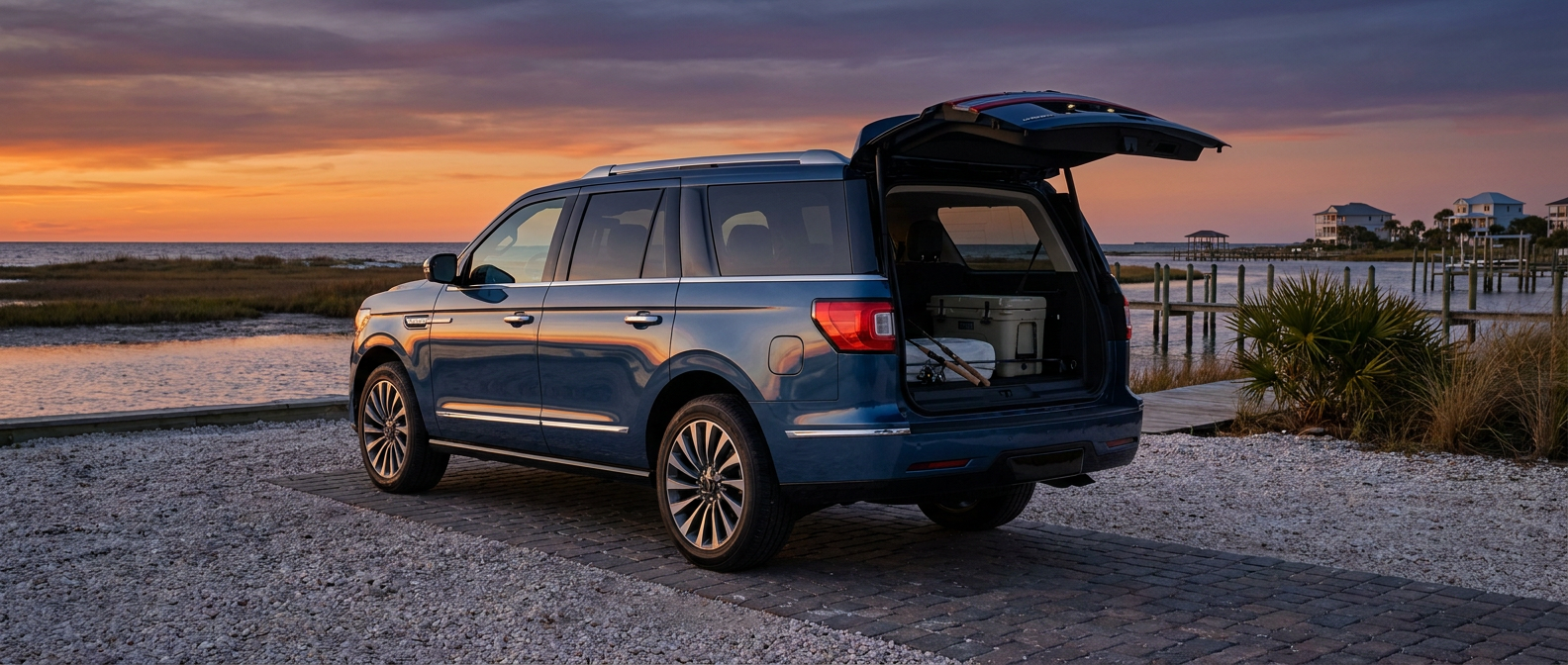
Most buyers come to a Navigator conversation carrying one reasonable assumption, that the L is simply bigger everywhere. More third-row legroom, more presence, more of all of it. The read is natural. It also happens to be wrong, and understanding why reshapes the entire test drive.
The "L" suffix adds exactly 11.9 inches to the overall length of the 2026 Lincoln Navigator. Lincoln puts all of that extra length behind the third row, not between the rows. Passenger space measures identical in both. What changes is cargo volume, and that single fact is the test you'll want to run before you decide.
We keep both configurations on our lot, parked where you can walk one into the other. Browse available Navigator L models and the pattern tends to hold. A buyer arrives sure the L is just "the bigger version," then leaves with a far clearer sense of what they actually need.
How Does the Navigator L Actually Differ from the Standard Navigator?
The mechanical answer is simpler than the badge suggests, because both the 2026 Lincoln Navigator and the Navigator L share the same 3.5-liter twin-turbocharged V6, the same 440 horsepower, the same 510 lb-ft of torque, and the same 10-speed automatic transmission, with Lincoln listing maximum towing at 8,700 pounds for both when properly equipped. The drivetrain is 4WD as standard across both. Same engine, same capability, same passenger dimensions in every row. What differs is purely structural.
| Dimension | 2026 Navigator | 2026 Navigator L |
|---|---|---|
| Overall Length | 210.0 in | 221.9 in |
| Wheelbase | 122.5 in | 131.5 in |
| Width (without mirrors) | 80 in | 80 in |
| Height | 78 in | 78 in |
| Cargo behind Row 3 | 21.6 cu ft | 37.4 cu ft |
| Cargo behind Row 2 | 60.8 cu ft | 75.4 cu ft |
| Max cargo (all seats folded) | 107 cu ft | 121.6 cu ft |
| Fuel tank capacity | 23.6 gal | 27.8 gal |
| EPA fuel economy (city/hwy) | 15/22 mpg | 15/22 mpg |
Two things jump out of that table. First, the width and height match exactly, so the L is no wider and no taller, and it won't change how the truck fits in a garage or a parking deck. Second, the fuel economy reads the same on both. Lincoln's EPA estimates for the 2026 Navigator L land at 15 city and 22 highway across all trims, matching the standard model.
Check the cargo figure behind row three with passengers aboard, because the number tends to surprise. Buyers expect 21.6 cubic feet to describe a folded-flat third row. It doesn't. The figure covers cargo space with the third row in use and people seated in it. Run three rows of passengers often and need to carry anything meaningful behind them, and 21.6 cubic feet feels tighter than most anticipate. The L's 37.4 cubic feet in that same configuration is a genuine operational difference, roughly the gap between a carry-on duffel per row-three passenger and a real set of checked-bag equivalents.
Both vehicles carry the same interior technology on equivalent trims. The 48-inch panoramic display spanning the full dashboard, the Lincoln Digital Experience platform with Google built-in apps and a 5G hotspot, and the class-exclusive Lincoln Split Gate (the two-section tailgate that opens both as a traditional liftgate and as a lower drop-down loading platform) are standard on the Premiere and up across both lengths. BlueCruise hands-free highway driving comes standard on all trims with a four-year subscription included.
Which One Fits How Bay County Drivers Actually Use an SUV?
Which Navigator fits comes down less to size for its own sake and more to how you load the thing, because both trucks drive the same roads with the same composure, and the split only shows up the moment you start counting what rides behind the third row. The conversation gets specific here, and it should.
Our market runs on US-98. The Hathaway Bridge over St. Andrew Bay is a 3,812-foot span that connects Panama City to Panama City Beach. Both the standard Navigator and the Navigator L stay composed across it. The adaptive suspension is shared, the cabin stays quiet in both, and BlueCruise will hold the lane without your hands once you reach a qualified divided-highway stretch. Neither vehicle announces itself with noise or float. That part of the comparison is a draw.
Where the distinction turns real is what you arrive with. See current Navigator inventory on a weekend run along the coastal corridor, whether that's a family of seven heading to the beach or a couple collecting guests at Northwest Florida Beaches International Airport (ECP) in West Bay and continuing east toward 30A, the Navigator L's extra cargo depth changes the logistics of the trip. Seven adults, their luggage, and the gear a Gulf Coast weekend tends to generate fill the standard Navigator's cargo space in a hurry. With the third row down and the PowerFold controls in the cargo area, the L takes on more without asking anyone to pack lighter.
The honest trade runs the other way. The Navigator L stretches to 221.9 inches, a length that rewards deliberate parking habits. Covered garages with low ceilings or a tight turning radius ask for more attention than the standard Navigator, which at 210 inches already qualifies as a lot of truck. If your days run two rows occupied and cargo rarely becomes the constraint, the standard Navigator covers the same roads with a touch more maneuverability in close quarters. The gap in usable cargo room just matters less to you.
For the households running all three rows on most trips, the L earns its length. Families with children, second-home owners who host often, professionals fielding airport pickups week to week. explore financing options for the L with that cargo reality in mind. The extended wheelbase isn't a luxury flourish; it's a practical spec that either matches your life or it doesn't.
Mini-Glossary: Navigator L Terms Worth Knowing
| Term | What It Means |
|---|---|
| Wheelbase | The distance between the front and rear axles. A longer wheelbase (131.5 in on the L vs. 122.5 in on the standard) contributes to a more planted highway ride and is where the extra cargo length originates. |
| PowerFold | Lincoln's powered third-row folding system. Accessible via controls in the cargo area, it lets you lower the second and third rows electronically without repositioning seats manually. |
| Split Gate | The Navigator's two-section tailgate. The upper three-quarters opens like a traditional liftgate; the lower quarter drops like a pickup tailgate, creating a loading platform or seating surface. |
| BlueCruise | Lincoln's hands-free highway driving technology. Active on pre-qualified divided highways using lane-centering cameras and attention monitoring. Included standard with a 4-year subscription on all 2026 Navigator trims. |
What This Means for Your Next Navigator
The question was never which vehicle is better, since they share an engine, a chassis philosophy, a cabin, and a technology platform; the decision comes down to whether the 15.8 cubic feet of additional cargo volume behind the third row justifies the L's extended footprint for how you use a vehicle. Call it the measurable, verifiable difference between 21.6 and 37.4 cubic feet with all three rows occupied.
For a Panhandle buyer who runs the US-98 corridor often, the 27.8-gallon fuel tank on the L (versus 23.6 gallons on the standard Navigator) reads as a quiet practical point, fewer stops on a run from Panama City to Pensacola or back east along the coast. It won't decide anything on its own. Still, it confirms the L was engineered for range, not just size.
Come drive both. A back-to-back answers this faster than any comparison chart. We'll put you in the standard Navigator first, then the L, on the same stretch of road. By the time you're back, you'll know.
View our current Navigator inventory to see what's available and confirm which configurations sit on the lot today.
We're here when you're ready.
Frequently Asked Questions
Is the legroom different in the third row of the Navigator L compared to the standard Navigator?
No. Lincoln builds the extended wheelbase of the Navigator L entirely behind the third row, adding length to the cargo area. The interior passenger dimensions, including third-row legroom. Are identical between the standard 2026 Lincoln Navigator and the 2026 Navigator L. The decision between the two configurations turns on how much cargo you need to carry when all three rows are occupied, not on how much room your third-row passengers have.
Does the 2026 Lincoln Navigator L get worse fuel economy because of its extra length?
The EPA ratings are the same for both configurations. The 2026 Navigator L is rated at 15 city and 22 highway across all trims, matching the standard Navigator exactly. The L does carry a larger fuel tank. 27.8 gallons versus 23.6 gallons on the standard model, which means it holds more fuel per fill rather than consuming it faster. On a longer Panhandle run, that translates to fewer stops between Panama City and Pensacola or along the coastal corridor east.