
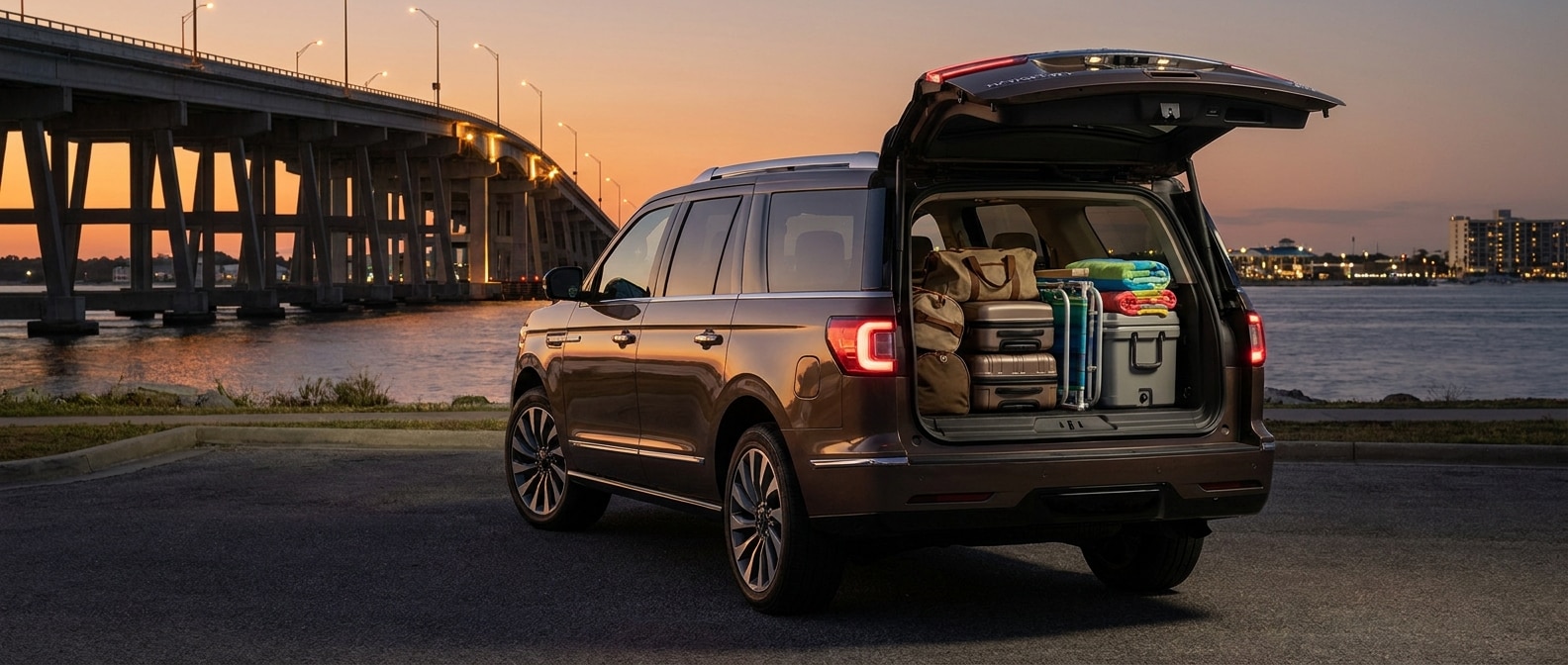
Navigator or Navigator L? The answer is simpler than the badge suggests. If you regularly fill all seven seats and still need real luggage space behind row three, the L earns every inch of its longer body. If that full-house scenario describes your Saturdays rather than your Tuesdays, the standard Navigator handles Bay County life with room to spare.
The 2027 Lincoln Navigator comes in two body lengths, three seating configurations, and one engine. Knowing what actually separates them saves a conversation that too often turns on the wrong question.
How Much Space Do You Actually Get?
The numbers Lincoln publishes tell this story cleanly, and they're worth knowing before you sit in either truck, because the two bodies share almost everything except the single figure that decides most purchases, the cargo room behind row three.
| Configuration | Behind Row 3 | Behind Row 2 | All Seats Folded |
|---|---|---|---|
| Navigator (standard) | 22.9 cu. ft. | 60.8 cu. ft. | 107.0 cu. ft. |
| Navigator L (extended) | 37.4 cu. ft. | 75.4 cu. ft. | 121.6 cu. ft. |
Lincoln lists the L as adding 11 inches of overall length and up to 14.5 cubic feet of additional cargo room compared to the standard wheelbase. The gap feels abstract until you try to load seven people plus a weekend's worth of gear behind row three. Twenty-two-point-nine cubic feet is roughly what you'd find in a midsize crossover's trunk. Thirty-seven-point-four is a different category entirely.
Both models share the same passenger volume, 172.1 cubic feet, by Lincoln's specifications. Your third-row adults get the same 37.4 inches of headroom and 43.5 inches of legroom no matter which body you pick. The extra length goes to the cargo hold, not to anyone's knees.
Browse Navigator L inventory if the cargo gap is the deciding factor for your household, and if it isn't, keep reading through the rest of this guide.
Which Seating Configuration Is Right for Your Family?
Seven passengers is the standard count, and eight is available if you choose the bench, so the right configuration comes down to whether a center aisle to row three or an extra seat matters more for the kids you actually carry every day.
The standard setup puts two captain's chairs in row two, opening a center aisle to row three. The aisle matters more than it sounds. With a car seat in row two, walking a toddler straight through to the third row without unstrapping anyone is a real daily convenience.
The available eight-passenger layout swaps those captain's chairs for a 40/20/40 PowerFold split bench. You gain one seat. You lose the aisle. For families with three children still in car seats, the bench opens up three-across fitment the captain's chairs simply can't match. For families running two car seats and older kids who can climb, the captain's chairs are the more practical daily arrangement (the aisle earns its keep every time a toddler walks back to row three).
Lincoln notes that the Black Label trim configures the second row as standard captain's chairs. The Reserve offers the bench as an option, and the Premiere makes it available too. The eight-passenger bench is a deliberate upgrade you choose.
One thing our team watches with families cross-shopping these two is how the open aisle of the captain's chair layout also makes it easier to load a third-row passenger while a rear-facing infant seat sits in row two, a detail the spec sheet never captures.
Where Do You Charge Locally? (For Bay County Drivers, Read: Where Do You Stage?)
We'll adapt the practical planning question for this market, because the thing that actually settles the Navigator versus Navigator L choice for Lynn Haven and Panama City Beach buyers has nothing to do with range or charging and everything to do with fit, and the question that decides it is simple, where does this vehicle fit your life?
Northwest Florida Beaches International Airport, or ECP, just west of Lynn Haven in West Bay, covers a familiar scenario for Lynn Haven families. An airport run with two adults, two checked bags each, and a car seat doesn't stress either configuration. Add three more family members and three more bags, and the 14.5 cubic-foot gap between the Navigator and the Navigator L shows up the moment you open the tailgate.
Along US-98, the standard Navigator slips into most parking structures and residential driveways without the extra thought a 221.9-inch vehicle asks for. The L stretches to that full length, and it isn't hard to place, though it does ask for a thought when you're parallel parking downtown or pulling into a tighter bay.
The split tailgate on both models earns its keep in coastal conditions. Its upper section rises like a traditional liftgate, and the lower section drops like a tailgate. That lower platform makes a useful staging surface for sandy gear or wet beach bags before anything goes into the cargo area.
- [ ] Count your regular passengers, because 7 vs. 8 is the first real question
- [ ] Assess your typical cargo load behind row three with all seats occupied
- [ ] Note whether a center aisle to row three matters for your car seat setup
- [ ] Measure your home garage depth if it's under 22 feet
- [ ] Consider whether ECP airport runs with a full party are a frequent scenario
- [ ] Test the split tailgate operation on both body lengths before deciding
See what's in stock at Bay Lincoln
How to Plan Your Decision
For most Bay County families, most of the time, the standard Navigator is the right answer, because it fits the coastal commute on US-98, handles the school run and the Saturday beach trip without drama, and seats seven with genuine comfort across all three rows.
The Navigator L justifies itself in one specific scenario. You're running seven passengers regularly, the luggage is real rather than a day bag, and the airport run or the weekend away repeats rather than happening once a year. In that case, the 14.5 cubic feet you gain behind row three stops being a luxury and becomes the reason to buy it.
The honest tradeoff with the L is length. At 221.9 inches against 210 inches for the standard, it asks for more attention in tight situations, and that's worth naming plainly rather than treating as a reason to walk away.
Come see either one on our lot in Panama City when you're ready to sit in both back rows and open both tailgates. No spec sheet does that part.
Frequently Asked Questions
Does the Navigator L have more passenger space than the standard Navigator?
No. Both the standard Navigator and the Navigator L share 172.1 cubic feet of passenger volume, according to Lincoln's published specifications. Headroom, legroom, and shoulder room are identical across all three rows in both body styles. The Navigator L's additional 11 inches of length and up to 14.5 cubic feet of extra space go entirely to the cargo hold, not to passenger seating dimensions.
Can the 2027 Lincoln Navigator seat eight passengers?
Yes, with the available second-row seat upgrade. The standard configuration places two captain's chairs in row two for a total of seven seats. An available 40/20/40 PowerFold split bench replaces those captain's chairs and adds an eighth seat at the center of row two. This option is available on the Premiere and Reserve trims; the Black Label comes standard with captain's chairs. Note that the center position of the bench seat relies on the vehicle seat belt rather than LATCH lower anchors for child seat installation.
Is 22.9 cubic feet behind the third row enough for a Bay County family trip?
It depends on how you pack. Twenty-two-point-nine cubic feet is a workable amount for two carry-on-sized bags or a light beach day for the family. A full weekend trip for seven with real checked luggage is where that figure starts to feel constrained. The Navigator L's 37.4 cubic feet behind row three adds the equivalent of a mid-size SUV's trunk on top of what the standard model already offers. If your regular trips involve seven people and a full week's gear, the L's extra length solves a real problem. If you carry lighter loads or regularly fold a row, the standard Navigator has more than enough room.