
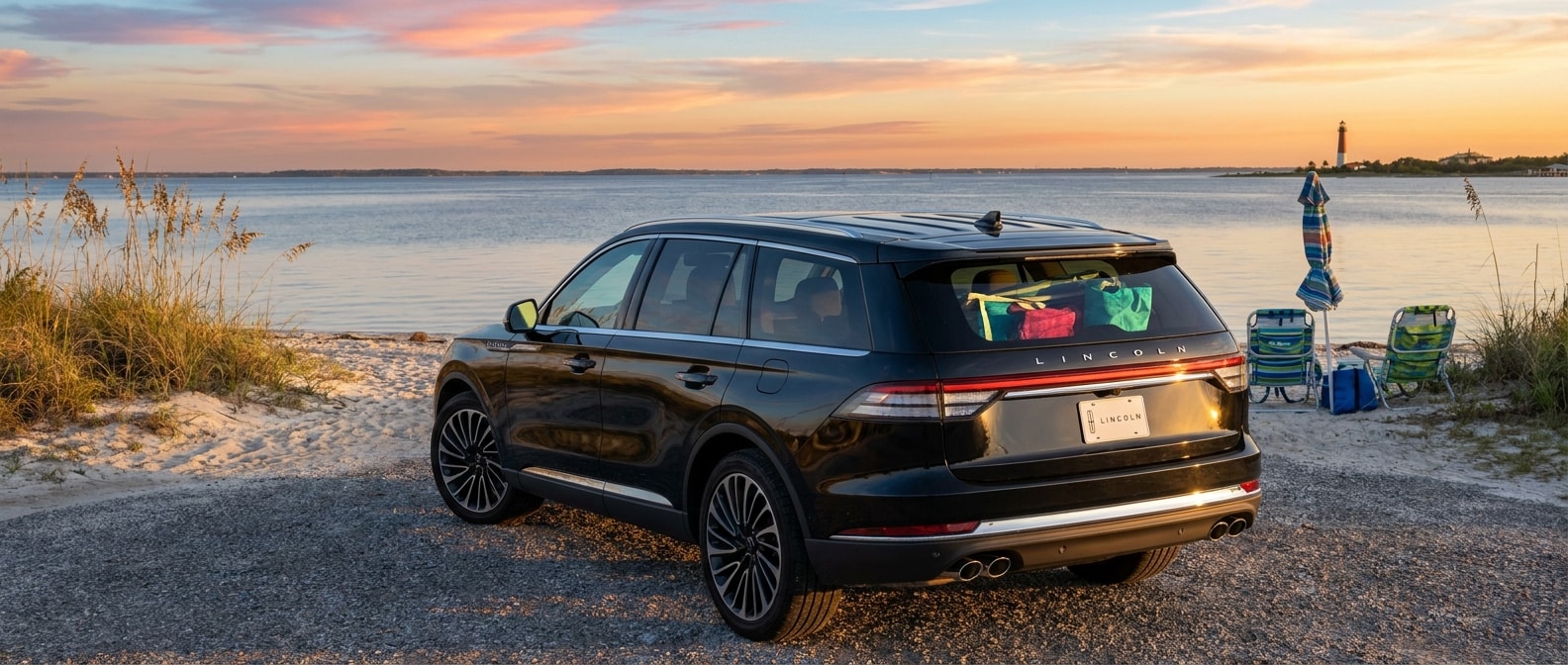
The stretch of US-98 from Grand Lagoon east through to Santa Rosa Beach ranks among the loveliest drives on the Gulf Coast. In summer and on holiday weekends, it's also one of the slowest. Picture two lanes through the 30A communities, a parking lot of lifted trucks and rental Jeeps, and a family that's been belted in since Panama City. Somewhere in there a vehicle either earns its keep or it doesn't.
For this corridor, The 2026 Lincoln Aviator fits better than most three-row SUVs, and we'd rather be specific about why. Not every feature on the sheet earns its place here. A few of them earn a lot.
Why Does the Aviator Fit This Drive?
The Aviator fits this drive because the conditions on the Grand Lagoon to Santa Rosa Beach corridor line up neatly with a short list of its standard features, and the table below maps one against the other. We've kept to verifiable specs and left the marketing language at the door.
| Local Condition | Aviator Feature | Why It Matters Here |
|---|---|---|
| US-98 stop-and-go with frequent lane changes | BlueCruise 1.5 hands-free highway assist (standard 2026) | Reduces fatigue on highway segments; automatic lane-change assist is new for 2026 |
| 30A two-lane, tight beach-town blocks | 360-degree camera system + front and rear parking sensors (standard) | Lets you find gaps and confirm clearance without guessing |
| Salt air and humidity on every coastal mile | Acoustic-laminated front door glass (standard) | Keeps wind and road noise out so conversation stays easy |
| Beach gear, coolers, and third-row passengers | 19.2 cu ft behind row 3; 75.9 cu ft all seats folded (Lincoln specifications) | Real cargo room behind the third row when everyone is seated |
| Patchy pavement and bridge expansion joints on 30A | Adaptive Suspension standard on Premiere and above | Reads and adjusts to road irregularities rather than passing them into the cabin |
| Hands full after a beach day | Hands-free, open-on-approach power liftgate (new for 2026) | Liftgate opens as you approach with the key fob on you; no hand required |
The Cargo Question Is the One That Actually Decides It
Three-row SUVs live or die on what sits behind the third row, so that's the number worth checking before anything else. The 2026 Aviator carries 19.2 cubic feet back there, which is enough for a large cooler, a bag of towels, and a pair of beach chairs standing upright, all with the rear seatbacks closed and everyone seated.
Fold that third row flat using the cargo-area button, and you're at 39.9 cubic feet. Fold both rear rows and you get 75.9 cubic feet. Lincoln specifies the PowerFold third row as standard, meaning the flip to cargo mode happens at the button rather than through a manual wrestle.
Browse our current Aviator inventory to see which trim configurations are available on our lot right now.
The plainer version goes like this. The Aviator isn't the answer if you regularly haul a full set of kayaks or a stack of surfboard bags. The wheelbase won't take that kind of oversize load with the liftgate closed. For a typical beach-family run with gear, coolers, and six or seven people, though, it works well, and the distinction is worth naming.
The Cabin Is Where the Coastal Drive Shows Up
The cabin is where this drive truly reveals a vehicle, because US-98 between Grand Lagoon and the 30A turnoff runs about 35 miles and summer traffic can stretch that past an hour. We pay attention to how a vehicle handles that kind of sustained low-speed driving, since it's a real part of Panhandle ownership and not just the weekend highway run.
Acoustic-laminated front door glass is standard across all 2026 trims. Paired with the active noise-cancellation system, it cuts the constant roar of US-98 at 25 mph with windows closed and climate control running. On a coastal drive where salt air and humidity push everyone toward keeping the windows up, that insulation earns its place, especially with kids in back.
The 2026 model also carries four-zone automatic climate control standard (three-zone on the Premiere, four-zone on Reserve and Black Label). Picture a beach run with a full load, one adult up front, another driving, a child asleep behind the second row. Independent climate zones mean you're not running the whole cabin cold just to keep the back row comfortable. On a hot afternoon the sun load through the rear glass builds fast before you've cleared the last light, which is where that rear zone actually counts.
In practice, the adaptive suspension reads the road surface continuously, and the patched pavement and steel expansion joints on the bridge approaches between Panama City Beach and 30A are exactly the repetitive input a passive suspension passes straight into the seat. The Aviator absorbs those without drama.
- The 2026 Aviator's EPA estimate is 18 mpg city / 25 mpg highway for RWD models, per the EPA; AWD rates 17 city / 25 highway. Stop-and-go on US-98 runs closer to the city figure.
- The 20.2-gallon tank (Lincoln specification) gives RWD models a combined estimated range of about 424 miles, per the EPA, before a fill.
- NHTSA rates the Aviator 5 stars overall for 2026.
- BlueCruise 1.5's automatic lane-change feature is new this model year and is standard.
- The hands-free open-on-approach liftgate is also new for 2026.
The One Tradeoff Worth Naming Plainly
The Aviator isn't fuel-efficient by current SUV standards, and that's the tradeoff to name before anything else. The EPA rates the AWD configuration at 17 city / 25 highway / 20 combined, and the stop-and-go reality of US-98 and 30A's beach-access streets means the city number is what you'll live with on this route far more than the highway figure.
So is the fuel number a dealbreaker? For some buyers on this corridor it is, since a full family load on constant stop-and-go makes fuel cost a real operating factor over time. None of that surprises anyone shopping a vehicle in the Aviator's weight class and power tier. For the buyer whose priority is quiet, space, and composure on a drive they're making regularly, the 3.0-liter twin-turbo V6 delivers 383 horsepower and 415 lb-ft of torque (Lincoln specifications), and the ride on a long coastal stretch feels different from a mainstream three-row.
This is the Aviator that fits the buyer who wants to stop noticing the drive by the time they reach Santa Rosa Beach. The Lincoln Navigator is worth a conversation if you're regularly towing a boat or need the L's added length for extended trips; the Nautilus makes the case for a two-row when a third row doesn't actually get used most runs. For the family that uses all three rows and wants the cabin to feel settled, this is the one.