
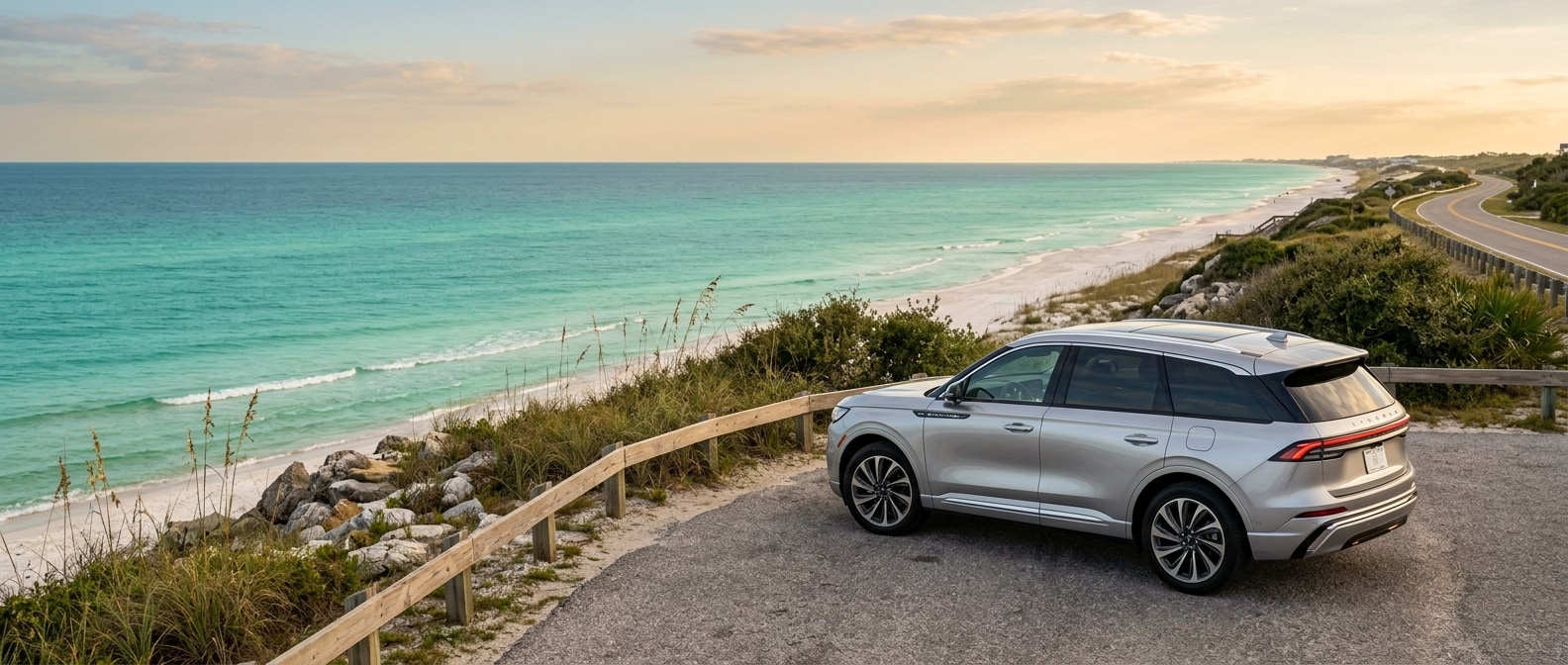
US-98 through Destin is one of the more revealing tests of a luxury SUV. On a summer Saturday it slows to 15-25 mph near the bridge approaches and harbor area, holds that pace for stretches, then opens back up toward the 30A communities east of Miramar Beach. You're not covering ground quickly. You're sitting in a cabin, listening to whatever the vehicle makes of that situation.
The 2026 Lincoln Nautilus handles it well, and we'll say so plainly up front. The cabin NVH engineering is genuinely strong, the light steering makes tight coastal parking lots easy, and the available hybrid powertrain turns the stop-and-go crawl into an efficiency gain where the gas model just burns fuel. We'll walk through exactly why, where the limits sit, and which three questions actually decide this for Panhandle buyers.
Browse the 2026 Nautilus at Bay Lincoln
The Nautilus is built around cabin quiet and ride comfort on long Panhandle drives. It fits the Destin corridor well for a family of five. It does not fit a buyer who needs to tow a boat.
Why Does This Vehicle Fit the Destin Corridor?
| Local condition or use | The feature that handles it | Why it matters here |
|---|---|---|
| Stop-and-go on US-98 in peak season | Available hybrid powertrain, EPA-rated 29 city / 30 combined mpg | City efficiency improves significantly over the standard gas model's 21 city mpg when you're crawling the harbor stretch |
| Tight parking at beach access points and Destin Harbor | Light steering, available automatic parking aids, 37.5 ft turning diameter | Maneuvers without drama in the narrow lots where parking fills fast on summer weekends |
| Long coastal runs east toward 30A communities | Cabin NVH insulation, adaptive suspension (Reserve and Black Label), supportive front seats | Road and wind noise are well controlled; the ride stays composed on two-lane coastal road |
| Salt air and subtropical humidity year-round | Standard AWD on every trim, all-season engineering | AWD is included, not an upcharge; it matters on a vehicle covering Gulf Coast roads year-round |
| Five passengers for a coastal weekend | Two-row, five-seat layout with 110.8 cubic feet of EPA passenger volume | Comfortably fits five without the footprint of a three-row |
| ECP airport runs (Northwest Florida Beaches International, West Bay) | 36.4 cubic feet of cargo space behind row two, standard remote start | Bags load easily; the cabin arrives composed |
The Cabin Quiet Is the Real Differentiator on This Route
The cabin is where the Nautilus makes its case on this route, and it's a case you can verify, with road and wind noise controlled, the hybrid nearly silent at low speed, and the ride soaking up the coastal expansion joints that would unsettle a firmer crossover. State it that way and the brochure falls away.
What does the Panhandle buyer who makes the US-98 run regularly actually talk about? Not horsepower. They'll tell you what a long drive does to them by the time they arrive, and that comes down to a cabin and ride conversation.
The 2026 Nautilus earns that reputation. Here's how it holds up on this route:
- Road and wind noise are "exceptionally well controlled," per reviewers who have tested it on highway drives.
- The hybrid is nearly silent at low speeds when the electric motor carries the load alone.
- The adaptive suspension, available on Reserve and Black Label trims, handles the expansion joints on the Mid-Bay Bridge and the rougher patches of coastal road, and it doesn't pass them into the cabin.
One owner with more than 7,500 miles on his hybrid put it plainly, "This vehicle is sublime on the highway and absorbs washboard roads with ease."
If a third row is a real requirement, see how the Lincoln Aviator compares before you decide
The steering is calibrated light at parking speeds, which helps in the narrow beach-access lots and the tighter restaurant parking along the harbor. It weights up well on the highway, and that's deliberate for this kind of use. It works.
The standard 2.0-liter turbocharged engine (250 horsepower, 280 lb-ft of torque, eight-speed automatic) is the honest baseline, and it doesn't hide its effort. Under hard acceleration, reviewers note a raspy engine drone that enters the cabin. That drone is the genuine limit of the standard gas model's refinement, and the hybrid is quieter in exactly that condition.
The EPA rates the 2026 Nautilus standard gas AWD at 21 city / 29 highway / 24 combined mpg, and the available hybrid AWD at 29 city / 31 highway / 30 combined mpg. Estimates; actual mileage varies with conditions, load, and climate-control use.
The Honest Tradeoff: One Limit Worth Knowing Now
The Nautilus tows 1,750 pounds with the available trailer towing package, per Lincoln's specifications, and that single number settles more buying decisions on this coast than anything else about the vehicle, so we'd rather put it near the top than bury it in the fine print. The figure covers a small personal watercraft or a light utility trailer. It isn't enough for a center console, a pontoon, or most of the trailerable fishing boats that Panhandle families run on St. Andrew Bay or into the Gulf.
Lincoln publishes the 1,750-pound figure for a Nautilus you've equipped with the towing package. The Navigator is the model Lincoln positions for heavier trailers.
If towing is part of your picture, the Nautilus is not the right answer, and that's a design choice rather than a flaw. The Lincoln Navigator is where that conversation starts. The Nautilus is a refined two-row coastal crossover built around comfort and quiet, and it doesn't try to compete in the towing category.
What it does offer for five people making the Destin run repeatedly is a cabin that absorbs the trip, seats that support you over a two-hour crawl, and a footprint that fits where parking is genuinely limited. For the right buyer, it's a clean match.
*Towing capacity noted at the published maximum for a properly equipped and configured vehicle. Verify your actual trailer weight before purchase.*
Gas or Hybrid? The Panhandle Case for Each
Local note: If your Destin trips run mostly in fall and winter, when US-98 flows freely and you're covering distance at highway speed, the standard gas model's 29 mpg highway EPA rating holds up well for a standard AWD luxury crossover. The hybrid's advantage concentrates in stop-and-go, which is the summer peak-season pattern on this corridor.
| Your driving pattern | Which powertrain fits | The honest reason |
|---|---|---|
| Primarily highway at speed, off-peak seasons | Standard 2.0L turbo, 29 mpg highway | Strong EPA highway rating for an AWD luxury SUV; no hybrid premium required |
| Summer weekends, repeated harbor and 30A crawls | Available hybrid, 29 city / 30 combined | Stop-and-go is where the hybrid earns it: 29 city vs 21 city on the gas model |
| Year-round Panhandle resident, mixed use | Hybrid makes the cleaner case over time | The efficiency gap accumulates over a full year of Gulf Coast driving cycles |
The hybrid adds 310 horsepower alongside the CVT, which reviewers consistently describe as nearly imperceptible in its transitions. The electric motor's immediate low-speed torque also makes the Destin stop-and-start rhythm feel less effortful, and that advantage shows most on a route that'll ask a lot of your patience.
Explore financing options at Bay Lincoln
What the Coastal Market Actually Tells Us
We service Lincoln vehicles in a Gulf Coast market, which means salt air is the operating context for every vehicle within a few miles of the water, and that's where we start reading a spec sheet like standard AWD before anyone asks about weather. The Nautilus includes standard AWD on every trim, and in a Gulf Coast market we treat that as a baseline expectation for durability, and we won't dress it up as a feature to upsell. Consistent traction on wet pavement, whether that's afternoon summer storms or damp October mornings, is simply what AWD means in this market, and the Nautilus delivers it without a trim upgrade.
The two-row footprint also reflects the Panhandle buyer profile we see. Someone considering the Nautilus has often already owned a three-row at some point. They know what they want, which is fewer people, less vehicle, more refinement per square foot. The Nautilus delivers that directly and without apology.
The Three Questions That Actually Decide This
Do you need to tow more than 1,750 pounds? If yes, the Nautilus isn't the vehicle, and the Navigator is where that conversation belongs.
Is your Destin run primarily summer weekends in traffic? If yes, the hybrid powertrain has a genuine efficiency argument, built on a verified 29 city mpg rating versus 21 on the standard gas model.
Are you considering a move from three rows to two? The Nautilus seats five in a smaller, more manageable footprint. If you're loading more than five people regularly, revisit the Lincoln Aviator before you commit.
For the buyer who answers no, yes, and two rows is fine to those three questions, the 2026 Nautilus is a clean match for this market. Quiet, composed, appropriately sized, and honest about what it is.
We're at 641 W 15th St in Panama City. Come in when you're ready.
By the Bay Lincoln Team | October 2026
Categories:
Social