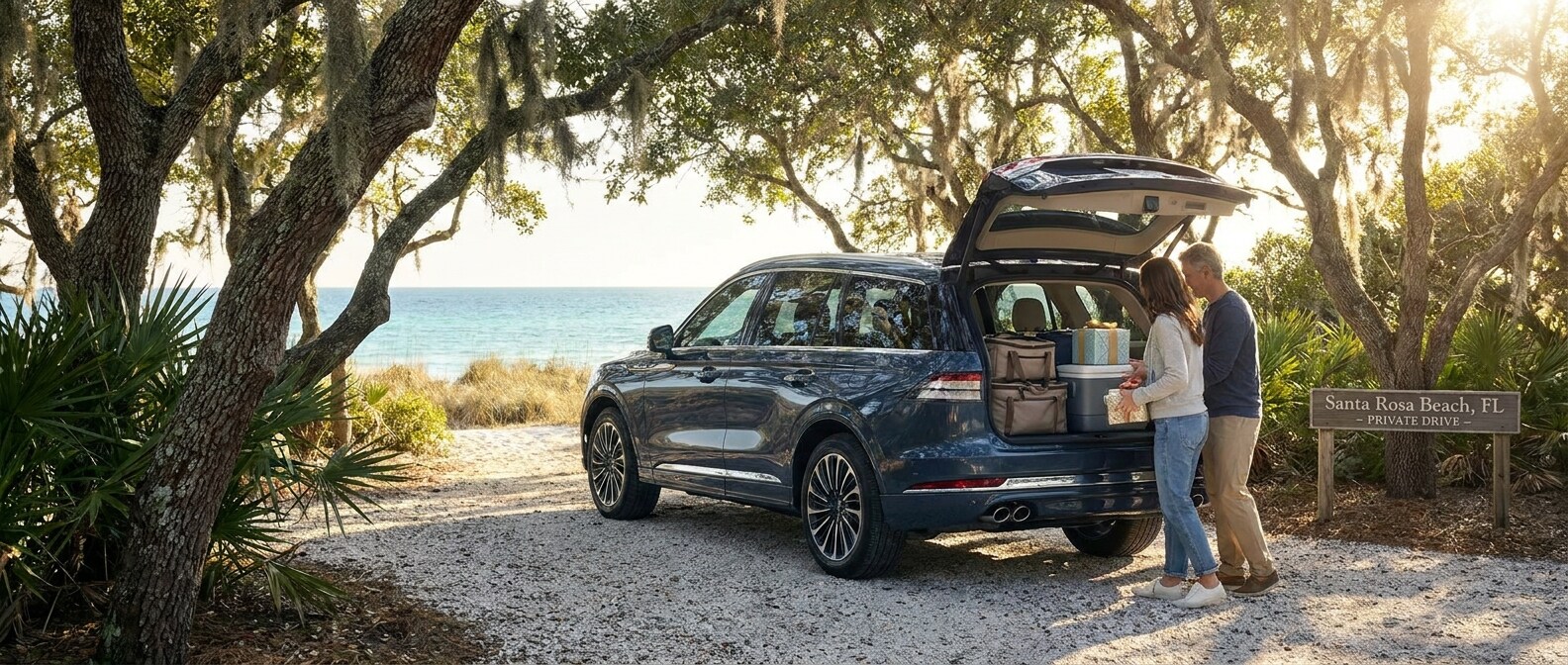
The holidays mean more miles on US-98, a loaded third row, and maybe a boat trailer swinging along behind you toward the coast. The Gulf Coast won't throw ice at you the way Chicago does, though it wears a vehicle down in its own quiet way. Salt-laden air, year-round humidity, and a full hurricane season's worth of hard starts all add up. None of this is complicated if you work the list now, before the travel starts.
The 2026 Lincoln Aviator comes well-equipped from the factory for Panhandle life. None of that means it maintains itself.
What Goes on the Checklist?
Work through these items in order before you load up, and each one takes less time than a single roadside stop would cost you on the way to the coast. Nothing here is busywork. The list is built around coastal stressors instead of Midwest ones, so start at the top and keep going.
| Item | Action | Why It Matters Here |
|---|---|---|
| Battery terminals | Inspect for white or greenish corrosion; clean if present | Salt air and Gulf Coast humidity accelerate corrosion on terminals and cables |
| Battery charge | Have the 12-volt tested under load | A marginal battery that starts fine in October can fail when temperatures drop into the 40s overnight |
| Cabin air filter | Inspect; replace if clogged or discolored | Coastal humidity and year-round pollen load filters faster than manufacturers' mileage intervals assume |
| Engine air filter | Inspect at the same time | Sand and fine coastal particulates accumulate, especially after a summer of open-window driving |
| Tire pressure | Check cold, adjust to door-jamb spec | Temperature swings from 85 degrees to 45 degrees overnight can drop pressure 4 to 6 PSI without a puncture |
| Tire tread depth | Measure with a gauge or coin test | Wet Panhandle roads, particularly bridge approaches, reduce stopping distance more than dry readings suggest |
| Windshield wipers | Test on the glass, not in your driveway | Salt film and UV haze the rubber; wiper streaking at highway speed on a rainy holiday drive is the worst time to find out |
| Brake fluid | Check level and color in the reservoir | Dark or murky fluid has absorbed moisture over time; humid coastal air speeds that process |
| Coolant level | Confirm at the overflow reservoir | The twin-turbo 3.0L runs warm under load; a low coolant level before a holiday highway run is worth catching now |
| All lights | Walk around the vehicle and test each one | Longer December nights and holiday traffic mean headlamps and brake lights are working harder |
| Tow hitch and wiring harness | Inspect the receiver and plug the trailer connector in | The Class III Trailer Tow Package is standard on every 2026 Aviator trim; the connector corrodes if it goes unchecked for a season |
| Undercarriage rinse | Have the service drive run a pressure rinse | Salt film collects on frame rails, brake lines, and suspension joints; a rinse before winter is the single most overlooked coastal step |
Why These Items Matter More Here Than a National Checklist Suggests
A generic November maintenance list gets written for a driver fighting road salt, frozen locks, and subzero cold starts, and none of that describes Bay County. Our stressors run different in kind, not just in degree. Heat, humidity, and salt film do the slow damage down here.
The battery earns its place at the top of this list. Heat, humidity, and the fine salt film that settles on everything near the Gulf Coast gang up to corrode battery terminals and cut a battery's effective life.
A battery that passed its last visual check can still carry a weakened charge. Lincoln's maintenance schedule recommends checking battery connections every six months.
If you park within a few miles of the water and that check hasn't happened since spring, now is the right time.
The 2026 Aviator runs a twin-turbocharged 3.0-liter V6 that Lincoln rates at 383 horsepower and 415 lb-ft of torque. That powertrain isn't fragile, though the 10-speed automatic does carry a transmission fluid specification worth confirming if you've been towing regularly. The Aviator's Class III Trailer Tow Package is standard across every trim level, which means a lot of Bay County buyers are putting it to work. Tow a boat or a loaded trailer out to Destin or Panama City Beach and back, and you lay measurable thermal stress on fluid that won't show its age until it's overdue.
Cabin air filters deserve a word of their own. Lincoln's recommended replacement interval runs roughly every 20,000 miles, and that figure assumes average conditions. Near the Gulf you're dealing with year-round humidity, salt particulates, pollen, and construction dust off a Panhandle that keeps building. Our service team pulls filters well past due before the mileage number ever flags them. If yours hasn't been changed in the last 18 months, pull it and look. A clogged filter chokes airflow through the HVAC system and leans on the blower harder during a seven-passenger holiday run.
The Why Behind Tires, Brakes, and Winter Night Driving on the Panhandle
Walton County and Bay County don't see snow, but they do see overnight temperatures that occasionally drop below 35 degrees, bridge surfaces that chill faster than the pavement around them, and December rain that shows up with less warning than a summer thunderstorm. Those are the conditions that quietly test tires and brakes. Our financing team hears this sometimes. People assume that because there's no winter here, tires and brakes can wait until spring, and we'd push back on that.
Wet roads at highway speed on US-98 or through Panama City Beach stretch your stopping distance out once tire tread falls below 4/32 of an inch. The NHTSA recommends replacing tires at 2/32 of an inch, and wet-weather grip starts fading well before that threshold. If your tread measures between 2/32 and 4/32, it's worth a conversation with our service team before holiday travel.
Check the brake fluid reservoir while the hood is already up. Coastal vehicles absorb humidity into the brake fluid over time, and dark or murky fluid in the reservoir signals that moisture content has risen. Moisture lowers the fluid's boiling point, which matters during sustained braking on a loaded run. The whole check takes two minutes.
Your Print-and-Go Holiday Prep Recap
Bring this list to your service appointment, or work through it yourself before the first long drive of the season. Either way, none of it needs to wait until spring.
- Battery terminals: inspect for corrosion; clean or service as needed
- Battery charge: test under load if the vehicle has more than three years on the original battery
- Cabin air filter: inspect; replace if it has been more than 18 months or is visibly dirty
- Engine air filter: inspect alongside the cabin filter
- Tire pressure: check cold against the door-jamb specification
- Tire tread: measure; replace if at or approaching 4/32 of an inch for wet-road confidence
- Windshield wipers: test on glass; replace if streaking or lifting at highway speed
- Brake fluid: check reservoir color; discuss replacement if fluid appears dark
- Coolant level: confirm at the overflow reservoir
- All lights: walk the vehicle, test headlamps, brake lights, reverse lights, and turn signals
- Tow hitch and wiring connector: inspect receiver and plug; clean corrosion from the plug contacts
- Undercarriage rinse: schedule at your next service visit
The Bay Lincoln service drive is on 15th Street in Panama City. If you'd rather bring the Aviator in and let our team run the full multi-point inspection before the holidays, we're straightforward about what needs attention now and what can wait.
Frequently Asked Questions
Does the 2026 Lincoln Aviator need AWD for Bay County winter driving?
Rear-wheel drive handles Bay County roads without trouble in normal conditions, and Lincoln's standard RWD configuration returns an EPA-estimated 18 city / 25 highway MPG, slightly better than AWD. The more practical question for Panhandle winter driving is tire condition. Wet roads on bridge approaches during a cold December rain are where tread depth earns its keep. If your tread is healthy and your tire pressure is correct, the Aviator's standard rear-wheel-drive setup suits this market well. All-wheel drive is available as an option on Premiere and Reserve trims and comes standard on the Black Label.
How often should I replace the cabin air filter on a Gulf Coast Aviator?
Lincoln's maintenance schedule suggests roughly every 20,000 miles as a general interval. Near the Gulf, salt air, coastal humidity, and year-round pollen and construction particulates load the filter faster than that interval assumes. We recommend inspecting the filter annually and replacing it when it's visibly dirty rather than waiting for a mileage trigger. A clogged cabin filter reduces HVAC airflow noticeably on a loaded vehicle in warm weather, which is exactly the condition you'll encounter on a Panhandle holiday drive.