Northwest Florida Beaches International Airport sits in West Bay, about 58 miles northwest of Port St. Joe along US-98. The coastal run is beautiful, and it's also the stretch where how well you packed the Navigator decides whether the trip starts on a high note or with someone riding a duffel on their lap.
Short version, the 2026 Lincoln Navigator handles this haul comfortably, and if you're regularly traveling with the full party plus a week's worth of gear, the Navigator L gives you a meaningful buffer. We'll walk through how to make it work.
Will It All Fit?
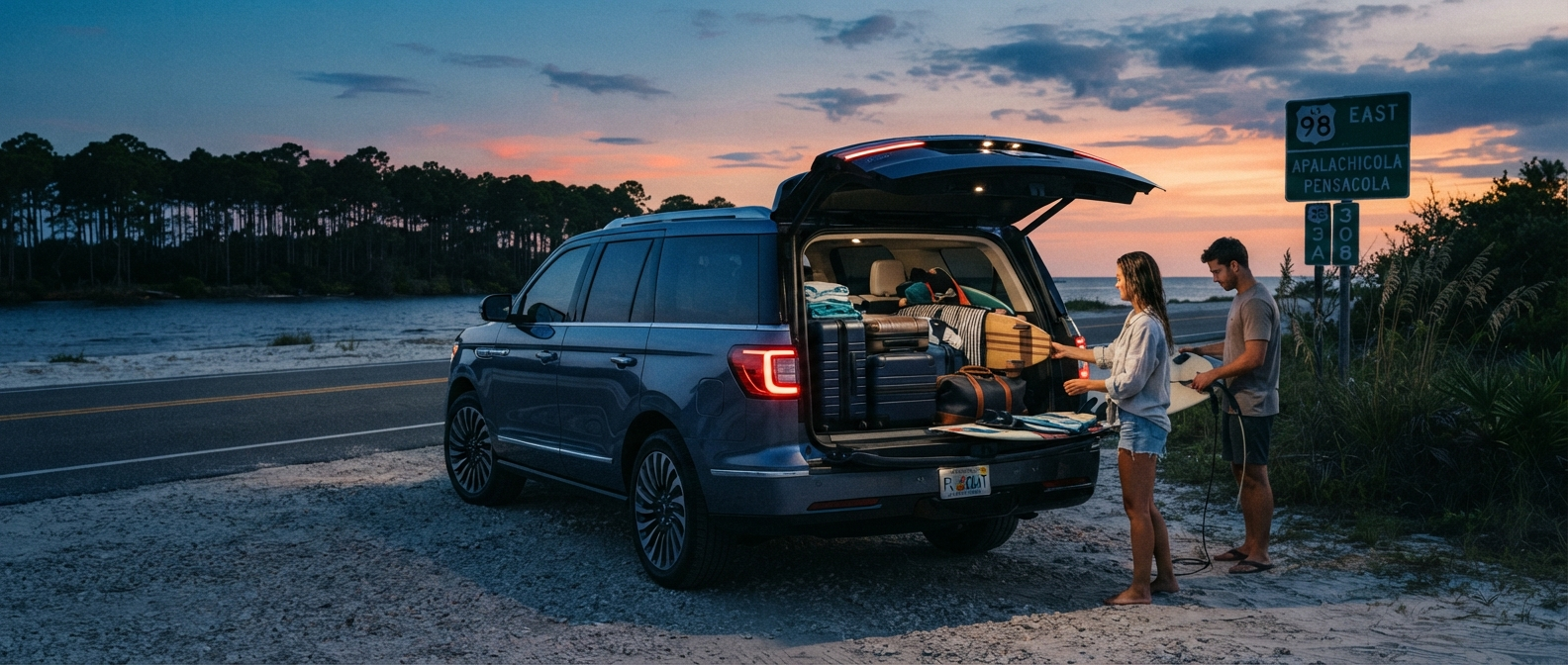
Yes, the Navigator handles this airport haul comfortably, with a few conditions worth knowing before you load at the curb, and Lincoln lists 22.9 cubic feet behind the third row on the standard Navigator and 37.4 cubic feet on the Navigator L, per Lincoln's published specifications. It fits. Those two numbers are the difference between fitting four hard-shell rollers and fitting six, and the rows fold flat by power, a setup Lincoln calls PowerFold, so dropping row three while someone waits at baggage claim takes about ten seconds.
The table below maps common ECP-pickup loads to what the Navigator actually offers. Specs are from Lincoln's official 2026 Navigator product page.
| Load Item | Dimension / Weight | Navigator (standard) | Navigator L |
|---|---|---|---|
| Hard-shell carry-on roller | Approx. 22" x 14" x 9" | Fits 4 upright behind row 3 | Fits 6 upright behind row 3 |
| Full-size checked bag (28" roller) | Approx. 28" x 19" x 12" | 2 standing + row 3 folded, 69.9 cu ft | 3 standing + row 3 folded, 84.5 cu ft |
| Surfboard bag (shortboard, ~6 ft) | ~72" x 24" | Rows 2 and 3 fully flat, 107 cu ft total | Fits flat with 14+ cu ft to spare, 121.6 cu ft total |
| Kayak paddle (breakdown, 2 sections) | Approx. 48" assembled | Fits flat across folded row 3 | Fits flat with room for paddle bag |
| Beach chair set (4 folding chairs) | ~36" folded | Stack against tailgate wall | Stack and still close the liftgate cleanly |
| Week's worth of soft-bag duffels (4 large) | 150 lbs / est. | Behind row 3, third row occupied | Rows all up, comfortably |
| Gear + 8 passengers | All seated, carry-on only | Tight but doable | Standard configuration |
Lincoln quotes an 8,700-pound tow rating when the Navigator is properly equipped, which matters if you're towing a boat trailer to Cape San Blas or one of the St. Joseph Bay launches. You won't need it for the airport run, but it tells you the platform has reserve capacity well beyond what a luggage haul asks of it.
One honest tradeoff is worth stating. The standard Navigator with all eight seats occupied and a full set of checked bags pushes its practical cargo limit, and if your party runs six or more adults traveling with real luggage, the Navigator L is the easier call. You get 37.4 versus 22.9 cubic feet behind row three, and that gap isn't a rounding error.
Loading It for the US-98 Run
The ECP-to-Port-St.-Joe drive runs roughly 58 miles southeast along US-98, through Mexico Beach and down the Gulf shoreline, and how you stack the cargo matters here because it's mostly two-lane once you clear Panama City, with wildlife crossings and occasional construction zones near the Bay-Gulf county line. Nothing dramatic, but not interstate either, and that shapes how you load.
Build the load in a set order and the cargo bay stays put on a winding coastal highway. The sequence our team finds cleanest runs like this.
- Fold the rows you need before you leave for the airport. The PowerFold third row drops from a button near the rear cargo area, so you're not wrestling seats in a parking structure. Decide row configuration at home, not curbside.
- Heaviest bags go in first, flat on the cargo floor against the seatback. Hard-shell rollers with wheels facing up resist tipping on turns.
- Stack softer duffels on top of the rollers. They compress and conform; they won't crack a corner on the wheel-well bump.
- Fishing rods, paddle bags, and anything over 48 inches goes flat along the driver's side with rows two and three fully folded. Lincoln puts the clear cargo width between the wheel wells at 48 inches in the Navigator L when both rows are down.
- Secure anything loose that can shift on a coastal two-lane. A mesh cargo net or a couple of cam straps costs almost nothing and keeps bottles and soft coolers from migrating forward under braking.
- Leave the front passenger floor clear for the bag that didn't fit or the carry-on someone insists on keeping in reach. Every group has one person. Plan for them.
Once row three is folded, load order decides whether you get a clean haul or a game of Tetris. The Navigator's cargo bay is 94.6 inches wide (mirror to mirror, per Lincoln's published dimensions), but the usable width between the wheel wells is narrower. A surfboard bag goes in diagonally unless the rows are fully flat and the board is shorter than the bay length.
The Navigator lineup on our lot includes both standard and L configurations, and our team can walk you through which fits your typical group size before you commit.
Gear That Fits, Trip That Runs Smoothly
The 2026 Navigator handles the ECP pickup run without drama, since the cabin stays quiet on the US-98 coastal stretch and 432 horsepower and 510 lb-ft of torque from the twin-turbocharged 3.5-liter V6, per Lincoln's 2026 spec sheet, make the merge onto the four-lane approaching Panama City effortless, even fully loaded. The adaptive suspension smooths out the occasional rough patch near Mexico Beach without any input from you.
What we tell people deciding between standard and L is simple. Think about the trip you take three or four times a year, not the ideal trip. If that trip usually involves six adults, surfboards, or a week of checked gear, the L's extra 14.5 cubic feet behind row three is the version you'll be glad you chose before you're standing at the curb sorting bags.
The Lincoln Aviator is the right choice for a smaller party or a shorter haul. But for a full eight-seat pickup at ECP with real luggage, the Navigator earns its floor space. Financing options are available for both configurations.
The job's done, with verified specs, a real route, and no surprises.