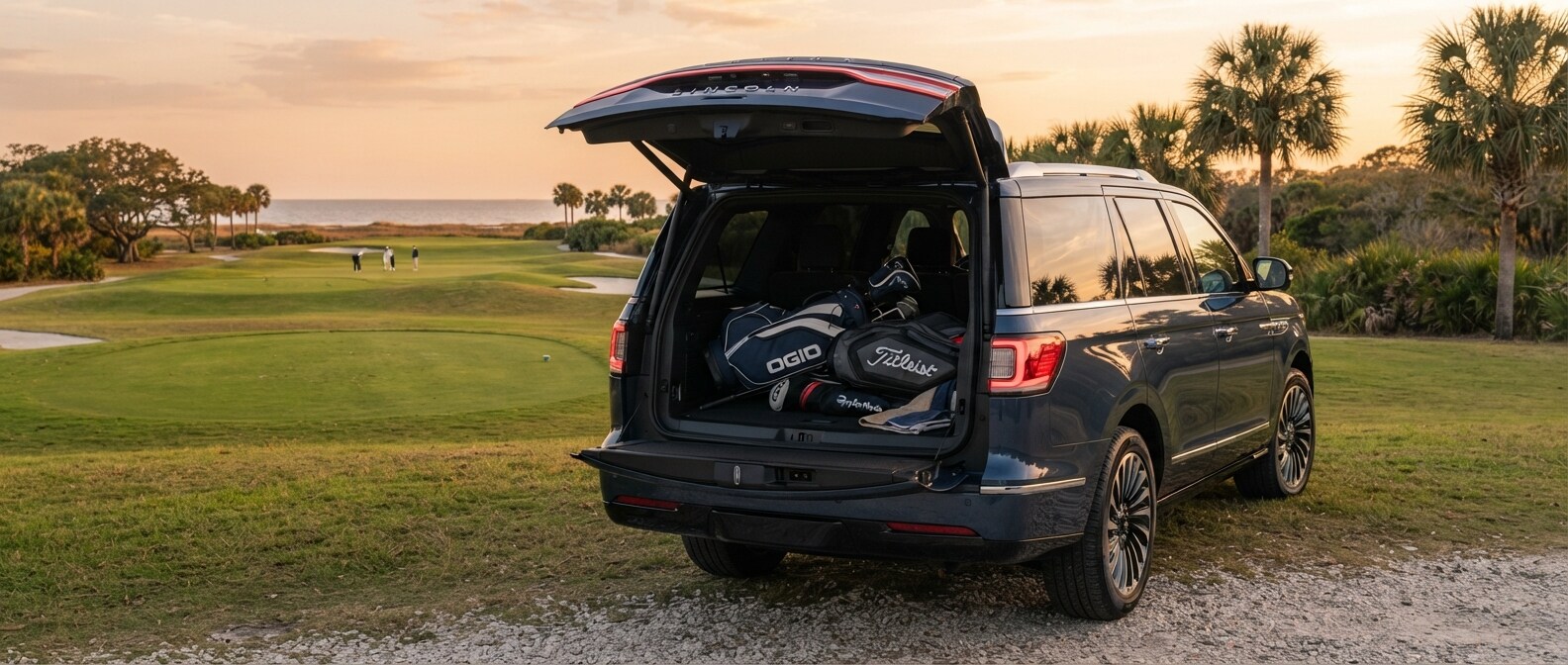
If your family's Thanksgiving itinerary includes a tee time somewhere along the Panhandle, and you haven't thought through what that does to your packing, we have. At Bay Lincoln this specific conflict comes up with the season: someone needs the third row for people, needs the cargo area for a turkey-week of luggage, and still wants two or three sets of Callaway clubs along. The good news is the 2027 Lincoln Navigator was designed, in several deliberate ways, as though that exact situation were the brief.
A few things are worth knowing before you load it.
What Do the Specs Actually Mean for a Golfer Packing for Thanksgiving?
The spec that matters first is cargo volume, and the Navigator gives you 22.9 cubic feet behind the third row with all three rows up and occupied. Generous, until you set a real golf bag beside it. A standard 48-inch bag, the full-size kind with a complete set of Callaway irons and a driver, runs roughly 50 inches standing, so you load it on its side.
Check the bag against the opening before you commit the back seats to people. Two bags fit if you're deliberate about it. Three is tight. Add two rolling suitcases and a soft cooler with the cranberry sauce, and you've made a choice, third row down or clubs in a roof bag.
Name the trade-off plainly. The Navigator is not unlimited space, full stop. What you get instead is a lot of room, organized with real intelligence.
| Configuration | Cargo Space | What Fits |
|---|---|---|
| All 3 rows up (standard) | 22.9 cu ft | 2 golf bags + 2 carry-ons |
| Third row folded (standard) | 69.9 cu ft | Full week of luggage + 3 bags with room |
| Both rows folded (standard) | 107 cu ft | Everything, including the folding chairs |
| All 3 rows up (Navigator L) | 37.4 cu ft | 3 golf bags + rolling luggage comfortably |
| Third row folded (Navigator L) | 84.5 cu ft | Full team, full gear, no negotiating |
| Both rows folded (Navigator L) | 121.6 cu ft | Maximum load, flatbed-flat floor |
Step up to the Navigator L and the math changes. It adds 11.9 inches of vehicle length over the standard model and gains 14.5 cubic feet behind the third row. For a family that travels with clubs often, the L isn't the bigger one for the sake of it; it's the one where the trade-off disappears.
Third-row passengers get 36.5 inches of legroom and 37.4 inches of headroom. Adults ride back there on a long Panhandle run without a complaint worth hearing.
The Split Gate Is the Feature Nobody Mentions Until They Use It
The Split Gate earns its keep at the exact moment loading usually goes sideways, the swing-and-shove at the end, because a conventional liftgate swings the whole door up and leaves you hoisting a 25-pound bag to shoulder height while dodging the top of the frame. Lincoln's Split Gate rethinks that motion.
The upper three-quarters lifts as a conventional gate. Its lower quarter folds down flat, like a tailgate on a truck. That lower panel hands you a loading shelf at a comfortable working height, so you set the bag down, orient it, then slide it in rather than heaving it over the bumper. A small detail, and it earns its keep on the first load.
The Navigator L pairs the same feature with a cargo area long enough that the bags sit lengthwise without crowding whatever rides beside them. Our team has watched people load a Navigator L with three full golf bags, two large rolling suitcases, and a bag of gifts and still close the Split Gate one-handed. The extra 14.5 cubic feet buys exactly that kind of ease.
The Gulf Coast Course Calendar Makes November a Real Window
Late November along the Panhandle delivers some of the year's best golf conditions, with the humidity that makes August miserable long gone and the coastal courses still holding their green. Tee times that stayed booked through October start opening back up, which is reason enough to point the Navigator north with the clubs aboard.
Topgolf Panama City Beach, adjacent to Pier Park, opened in 2025 and runs 74 outdoor hitting bays across two levels. For the traveling golfer whose family wants something social instead of a full 18 holes, it absorbs an afternoon without anyone having to agree on a handicap. The drive up the coastal corridor on US-98 stays easy in something Navigator-sized, and the width never feels like a problem on a road built for this scale of traffic.
The Lincoln Aviator makes a strong case when the golf-bag count is lower and passengers are the priority. Bring the clubs and the whole family, though, and the Navigator's cargo math becomes a different conversation.
Who the Navigator Actually Fits
The 2027 Navigator suits a specific buyer, and it's worth naming that buyer plainly rather than softening it into anyone who needs space. Travel with a full house and a full load, week-long luggage, coolers, gifts, and the clubs, and this is the vehicle built around that reality; fill it rarely, and the size becomes overhead you pay for daily.
| Fits Well | Worth Considering Instead |
|---|---|
| Family of 5-7, traveling with full luggage | Smaller group, only 1-2 bags of luggage |
| Golfers who bring 2-3 bags regularly | Golfers who travel with clubs occasionally |
| Frequent holiday travel to Panhandle or 30A | Primarily local driving in Panama City |
| Buyers who want third-row adults, not just kids | Third row is occasional/children only |
| Buyers who tow (up to 8,700 lb capability) | No towing need at all |
No way around it, the Navigator is not a small vehicle. At 210 inches in standard form, it wants to be driven with real awareness of its length in parking structures and tighter lots. For anyone moving up from a midsize SUV, that's the genuine trade-off, you gain the space and you adjust to the footprint.
What it does well, it does without making you give up anything else. The twin-turbocharged 3.5-liter V6 makes 440 horsepower and 510 lb-ft of torque, so loaded to the ceiling on I-10 or merging onto US-231 north toward Marianna, it never labors. Lincoln BlueCruise hands-free driving assistance, standard on Premiere, handles the long straight interstate segments with appropriate driver oversight, working as an aid rather than a replacement for an attentive driver.
For the buyer weighing the Navigator against the Lincoln Nautilus, the Nautilus answers best when the third row isn't needed and you want something easier to place in a tight space. Calling it a lesser vehicle misses the point; it's simply a different one. The Navigator earns its size when the whole family travels with everything they own for a week.
Explore financing options if you're working through the full picture before the holidays.
Frequently Asked Questions
Does the 2027 Lincoln Navigator have enough cargo space for golf bags and passengers at the same time?
With all three rows occupied, the standard Navigator offers 22.9 cubic feet behind the third row. Two full-size golf bags fit alongside a couple of carry-on pieces in that configuration. If you're bringing three bags, the Navigator L's 37.4 cubic feet behind the upright third row solves that without folding a seat. For a family of seven plus a full set of clubs, the Navigator L is the vehicle that makes the math work without asking anyone to ride with their knees in the seat.
What is the Lincoln Split Gate and why does it matter for loading?
The Lincoln Split Gate is a class-exclusive rear closure that opens in two separate sections: the upper three-quarters lifts like a conventional liftgate, and the lower quarter folds down flat like a truck tailgate. That lower panel creates a loading shelf at a natural working height, which makes sliding in a heavy golf bag, or a cast-iron Dutch oven. Significantly easier than the shoulder-height lift a conventional liftgate requires. It also acts as a seat at the tailgate if you need one while you're waiting on the rest of the group.