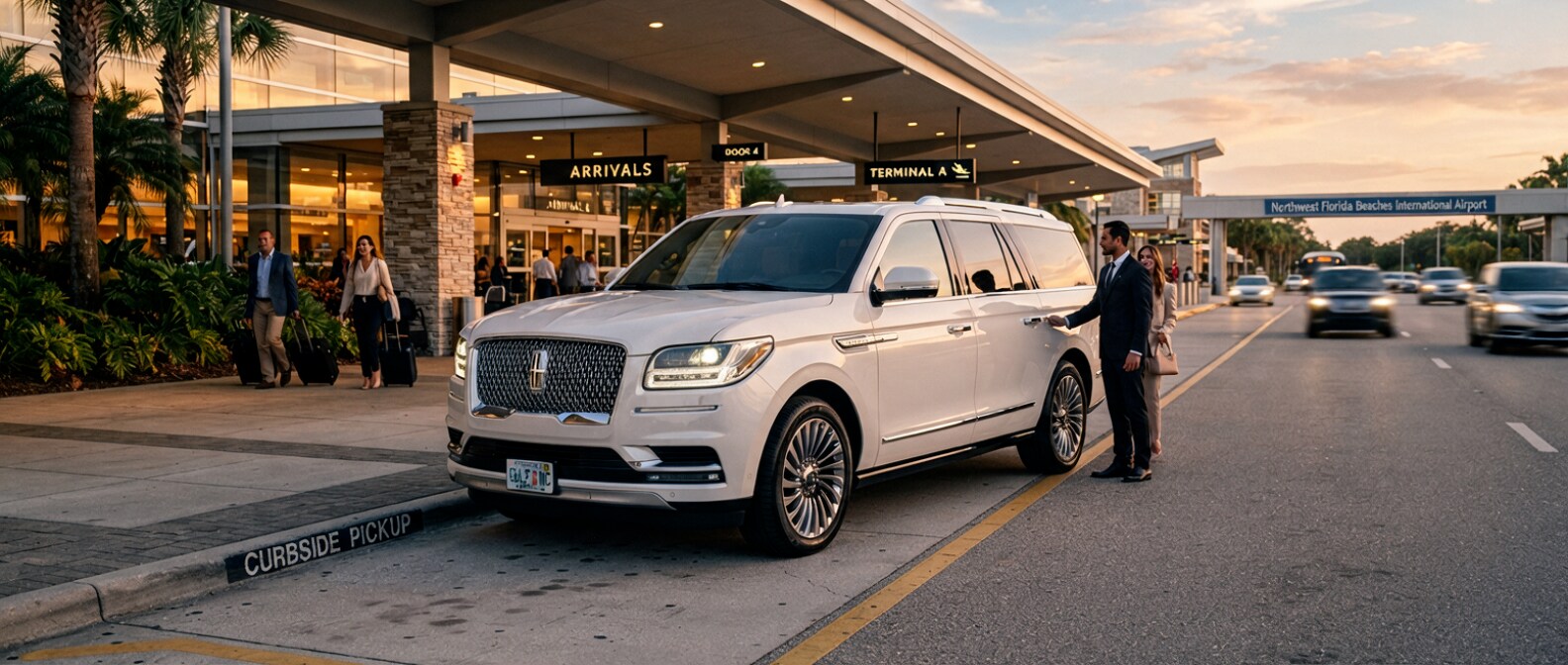
Plan a pickup from Northwest Florida Beaches International Airport for family coming in from Port St. Joe, and you'll hear some version of the same line. "That's too much vehicle. The standard Navigator is plenty." We hear it, and we understand where it comes from. But the moment you're at the curb with six people, a week's worth of luggage, and a 90-mile drive east on US-98 ahead of you, the conversation changes.
The myths get a few things wrong, and the numbers tell a plainer story.
- The Navigator L's 221.9-inch length fits standard airport pickup lanes; the Split Gate loads luggage faster than a conventional liftgate at a crowded curb.
- Behind the third row, the standard Navigator offers 22.9 cubic feet. The L gives you 37.4. That 14.5-cubic-foot gap is real when all three rows are occupied.
- BlueCruise comes standard for four years on every 2027 Navigator L trim, and that matters on the ECP-to-Port St. Joe run more than most buyers expect.
- The honest tradeoff: 221.9 inches asks for a wider parking arc in tight lots. It is a real consideration.
- For a family of six flying into ECP and heading east on US-98, the L is not overkill. It is sized for exactly that use.
Is the Navigator L Actually Too Big for ECP?
No, and the worry is understandable, even reasonable, though it quietly blurs two different things, the overall length of the vehicle and how tricky it is to maneuver. Those are not the same problem, and the L handles the second one far better than its footprint suggests.
At 221.9 inches overall, the Navigator L runs about 11.9 inches longer than the standard-wheelbase model. That's a real number. It isn't the same as unmanageable at a commercial airport pickup lane. ECP's terminal loop is a standard single-lane curbside structure, the same format used at regional airports across the Southeast, and full-size SUVs are common there. The Split Gate changes the curb experience in a way you feel right away; its lower panel drops like a tailgate while the upper lifts clear, so you're loading bags from the side instead of hoisting them over the full height of a traditional liftgate opening. At a busy curb, where you get one shot to load before a traffic attendant waves you on, that design earns its keep.
The limitation we do want to name is the turning footprint, which is wider than a crossover's. In a compact parking structure or a narrow lot, that matters. ECP's surface parking is open, but if the plan runs through valet or a tighter hotel garage, give yourself extra time on the first approach.
| Myth | What's Actually True |
|---|---|
| The Navigator L is too large for ECP pickup lanes | At 221.9 inches, it fits standard curbside lanes; the Split Gate loads faster than a conventional liftgate |
| The standard Navigator has enough cargo for a family | Only 22.9 cu ft behind row 3 with seats up; the L offers 37.4 cu ft, a gap of 14.5 cubic feet |
| BlueCruise is unnecessary for a short airport hop | ECP is 18 miles northwest of Panama City; the return run to Port St. Joe on US-98 is real highway driving |
| AWD is essential for the Gulf Coast airport route | The PSJ-to-ECP corridor is flat coastal highway; RWD handles it; AWD is a capability upgrade, not a safety requirement here |
| The L's third row is uncomfortable because of the stretch | Legroom in the third row is 36.5 to 43.5 inches, the same as in the standard Navigator |
What Those Extra 14.5 Cubic Feet Actually Mean on a Family Pickup
The extra 14.5 cubic feet turn an abstract spec into the plain difference between everyone's bags fitting and not, and that's exactly where this choice stops being theoretical and starts shaping a real pickup. For two or three people with carry-ons, the standard model is plenty. For six with checked bags, it stops being enough. Our inventory carries plenty of Navigator L buyers who came in picturing the standard model as the answer.
Check the cargo figures before you assume the shorter body covers it. The standard Navigator, with all three rows upright, holds 22.9 cubic feet behind the third row, roughly two carry-on rollers and a medium duffel. Add a third adult's bag and you're reorganizing. The Navigator L, at 37.4 cubic feet behind the same third row in the same full-seat configuration, gives you room to work. The difference comes down to whether the vehicle fits the trip or asks everyone to hold something in their lap for 90 miles, and that's not a comfort question at all.
One thing our team notices on the lot is that buyers who underestimate this gap are almost always picturing a half-empty vehicle. They're right that the standard Navigator is spacious; it is. The L's argument isn't headroom or legroom (those are identical across both wheelbase lengths) but the specific cubic footage behind a third row of adults who are actually sitting there.
Explore financing options when you're ready to look at trims.
Does the US-98 Run Justify the L's Full-Size Footprint?
It does, and the route itself is the reason we keep framing it that way, because the ECP-to-Port St. Joe drive is open highway rather than stop-and-go, the sort of sustained-speed running where a full-size flagship's composure shows up most. The road rewards a vehicle that can settle in and stay quiet.
The route runs east along US-98, a two-lane coastal highway that stretches across the Florida Panhandle, and it's no commuter crawl, just long straightaways, the odd construction window, and the kind of sustained-speed driving where a flagship earns its billing. The 2027 Navigator L's twin-turbocharged 3.5-liter V6 produces 440 horsepower and 510 lb-ft of torque, so it isn't working hard at highway pace. The cabin's enhanced active noise control keeps road and wind noise low even at speed. That counts for a lot when the people you just picked up have been in an airport since before dawn.
BlueCruise, included for four years on every 2027 Navigator L trim, is a hands-free highway driving aid that operates on mapped divided highways, and the PSJ corridor of US-98 qualifies. Used as it is designed, with the driver attentive and eyes on the road, it trims the micro-fatigue of a long, straight Panhandle run rather than showing off.
The trade-off worth naming is fuel. The Navigator L runs on premium fuel, and the numbers on a loaded run won't rival a midsize crossover. Build it into the plan up front. The tank is large enough that you won't need a stop on the way back from ECP to Port St. Joe, but this isn't a vehicle for anyone hoping to minimize fuel conversations. It never claimed to be.
View Current Navigator L Offers
So What Should You Actually Choose for the ECP Run?
For a solo trip or a couple traveling with light bags, the standard-wheelbase Navigator is a composed, capable choice and genuinely the right one, so if that's your trip we'll point you straight at it rather than talk you into more body. See standard Navigator options on our site.
For a family of four or more flying into ECP with checked luggage, headed east toward Port St. Joe? The L earns it. The 14.5 extra cubic feet, the Split Gate at the curb, BlueCruise on the highway home, every one of those is a specific, verifiable reason you can check. The Navigator L is longer than a crossover, and it parks differently, and both are trade-offs worth knowing before you commit.
If you'd like to walk through the trims or see what's on our lot, our team at Bay Lincoln is straightforward about the differences. No pressure in either direction. Bring us your situation, and we'll give you the honest answer.
Frequently Asked Questions
Is the 2027 Lincoln Navigator L too long for airport curbside pickup?
At 221.9 inches overall, the Navigator L fits standard commercial airport curbside lanes without special maneuvering. The class-exclusive Split Gate simplifies curb loading by opening in two sections, with the lower panel dropping for bag loading and the upper lifting clear. The main parking consideration is tight structures or compact lots, where the wider turning footprint requires more attention than a midsize crossover would.
Does the 2027 Lincoln Navigator L have enough cargo space for a full family pickup from ECP?
With all three rows occupied, the Navigator L holds 37.4 cubic feet behind the third row. The standard-wheelbase Navigator holds 22.9 cubic feet in the same configuration. The 14.5-cubic-foot difference is what distinguishes a vehicle that fits everyone's checked luggage from one that asks passengers to hold bags on their laps for a long highway return. With the third row folded, the L expands to 84.5 cubic feet behind the second row.