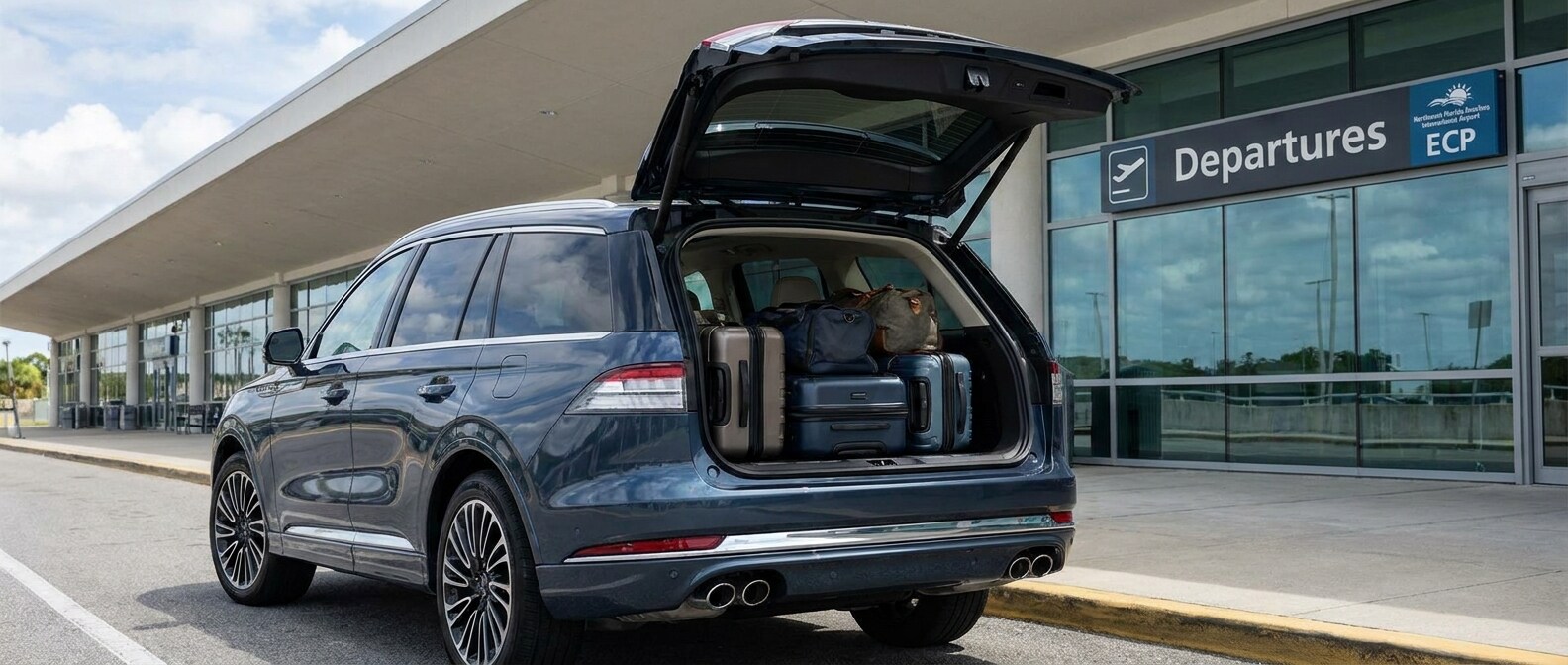
The night before you drive out to ECP, it's tempting to grab the keys and go. That works fine until four passengers land with six checked bags, somebody's installed a car seat in row two, and the third row is still up. Then you're standing in the curbside lane reconfiguring the cabin while a Southwest flight worth of traffic idles behind you.
So how much room does the Aviator actually give you? Behind the third row, with all seats occupied, you get 16.5 cubic feet, enough for carry-ons and not much past that. Load up a family of four coming home from a week away and the math falls apart. The good news is small and practical. A few minutes of prep the evening before turns a spatial puzzle into an effortless pickup. We'll walk you through exactly how.
Browse 2026 Lincoln Aviator inventory at Bay Lincoln
What You Need Before You Start
A quick inventory before you touch a single seat is what saves you the most time at the curb, so run your eyes down this reference while you plan who's sitting where and which bags ride where, then keep it handy as you load the car. It's a short check that pays off the moment you reach the terminal.
| Item | 2026 Aviator Spec | Why It Matters for ECP |
|---|---|---|
| Cargo behind row 3 (all seats up) | 16.5 cu ft | Carry-ons only; plan to fold if bags are checked |
| Cargo behind row 2 (row 3 folded) | 39.9 cu ft | Comfortable for 2-4 checked bags |
| Cargo behind row 1 (both rows folded) | 75.9 cu ft | Full-family luggage load |
| Row 3 PowerFold control location | Cargo-area side panel button | Folds flat without entering the cabin |
| Row 3 legroom | 29.2 inches | Appropriate for shorter adults or kids on a 30-minute ride |
| Row 2 legroom | 39 inches | Adult-comfortable for the drive in from downtown |
| ECP distance from downtown Panama City | ~18 miles via SR-77 north | Plan roughly 30 minutes; allow extra during peak summer season |
| Fuel tank | 20.2 gallons | EPA range ~424 miles RWD; no fuel stop needed for this run |
Specs per Lincoln and EPA (fueleconomy.gov) for the 2026 model year. Actual cargo capacity limited by weight and distribution.
Configuring the Cabin: Six Steps from Driveway to Curbside
Configuring the cabin is the spine of this whole pickup, and it comes down to six unhurried steps you run in the driveway rather than six frantic ones you improvise at the curb, so take them in order and nothing about the morning feels rushed. See current Aviator trims in stock if you're still deciding which configuration suits your household before you work through these steps.
Step 1: Count your passengers and their bags the night before.
Pull up the flight itinerary and get literal about it. Count the adults, the children, and the checked bags. A family of five with three checked bags is a different cabin than two adults with carry-ons, so write the numbers down. It sounds obvious. Doing it the evening before is what lets every later step happen calmly.
Step 2: Decide whether the third row goes up or down.
Row 3 gives you 29.2 inches of legroom, which is a sensible ride for kids or for the 30-minute trip from ECP back to downtown Panama City. Stretch it longer than that and tall adults won't thank you. If everyone's an adult and the bags are checked, fold the row. If you're collecting grandchildren and two parents, the row stays up and you pack around it.
Step 3: Fold the third row using the cargo-area button.
Lincoln's PowerFold third-row seat folds flat at the press of a button on the cargo-area side panel, so you never have to climb into the cabin. When we stage an Aviator on the lot, standing at the rear and dropping that seat from one panel button is the step that makes people exhale. Families who routinely carry six or seven adults may want to consider the Lincoln Navigator for a larger footprint. The 39.9 cubic feet behind a folded third row swallows two to four standard checked bags with room to spare.
Step 4: Stage your cargo area before you leave.
Put anything you're carrying to the airport (empty garment bags, a stroller frame, a cooler for the drive home) into the cargo area now, in the order things will come out. Whatever goes in last should sit closest to the liftgate. Nesting bags inside a stroller frame before you leave the driveway saves you three minutes of fumbling at the curb.
Step 5: Set the second row for your arriving passengers.
The standard captain's chairs in row two slide and tilt through a power tip-and-slide release on the seatback. If a car seat is installed in one of the outboard positions, slide it forward now so the arriving passenger can step past it. If you're collecting someone who finds entry difficult, send the seat rearward to its full travel of 39 inches of legroom before you arrive. It's well worth doing in advance.
Step 6: Pull up the route and check the curb procedure at ECP before you leave.
From downtown Panama City, take SR-77 north through Lynn Haven and Southport, then turn left onto SR-388. The airport entrance sits on the right after roughly 8 miles on SR-388. ECP's curbside arrivals lane is a single-direction pull-through. Drivers picking up one or two passengers from shorter trips may find the Lincoln Nautilus suits the run just as well. The Aviator's hands-free liftgate, available on Reserve and above, lets you open the cargo area without setting down what you're carrying. Know which carrier and terminal door your arriving party will use before you get there.
Print-and-Go Checklist
Use this the evening before your ECP run.
- [ ] Confirm passenger count and bag count from the flight itinerary
- [ ] Decide third-row configuration (up for more passengers, folded for more cargo)
- [ ] Press cargo-area PowerFold button to fold third row if needed
- [ ] Stage cargo area: largest items first, closest to the rear
- [ ] Adjust row-two captain's chairs and any installed car seat
- [ ] Check fuel level (the 20.2-gallon tank gives an EPA-estimated ~424 miles of range on RWD; you almost certainly don't need to stop, but confirm)
- [ ] Pull up SR-77 north to SR-388 and confirm flight arrival time
- [ ] Note arriving airline and door number at ECP so you go straight to the right spot
A Recap for the Drive Out
By the time you back out of the driveway, the hard part's already behind you: the cabin is configured, the cargo area is staged, and the route already lives in your memory before you reach the end of the street. What holds true on the drive itself is the powertrain. The 2026 Aviator's 3.0-liter twin-turbo V6, rated by Lincoln at 383 horsepower and 415 lb-ft of torque, pulls a full load out of ECP without a second thought. The EPA puts highway fuel economy at 25 mpg for the RWD configuration, so a drive of this length barely registers at the pump.
The straight talk on row three is simple. It's a good seat for a 30-minute ride. It seats two, and Lincoln designed it for exactly this kind of trip. For a taller adult parked back there longer than the drive from West Bay Parkway back downtown, the second row is the kinder choice. None of that is a failure of the vehicle. It's the plain geometry of a midsize three-row, and knowing it in advance is what lets you seat people correctly before the doors close at ECP.
We find that the clients with the smoothest Aviator airport runs are the ones who treat seat configuration as part of the trip and never as an afterthought at the curb. It's a 10-minute job at home. A non-event at ECP.
View Current Lincoln Aviator Offers
Frequently Asked Questions
Does the 2026 Lincoln Aviator have enough cargo space for a family airport pickup?
It depends on configuration. With the third row folded flat using the cargo-area PowerFold button, the Aviator offers 39.9 cubic feet of cargo space, which is comfortable for two to four standard checked bags alongside passengers in row two. With all three rows occupied, cargo space behind row three is 16.5 cubic feet, which fits carry-on luggage but not a full set of checked bags. Planning your seat configuration before you leave home is the practical solution.
How far is Northwest Florida Beaches International Airport from downtown Panama City?
ECP is approximately 18 miles from downtown Panama City, via SR-77 north through Lynn Haven and Southport to SR-388. The official airport directions list the drive at roughly 30 minutes under normal conditions. Allow additional time during peak summer travel weeks when SR-77 through Lynn Haven carries heavier traffic. By the Bay Lincoln Team | November 2026